May 17, 2026
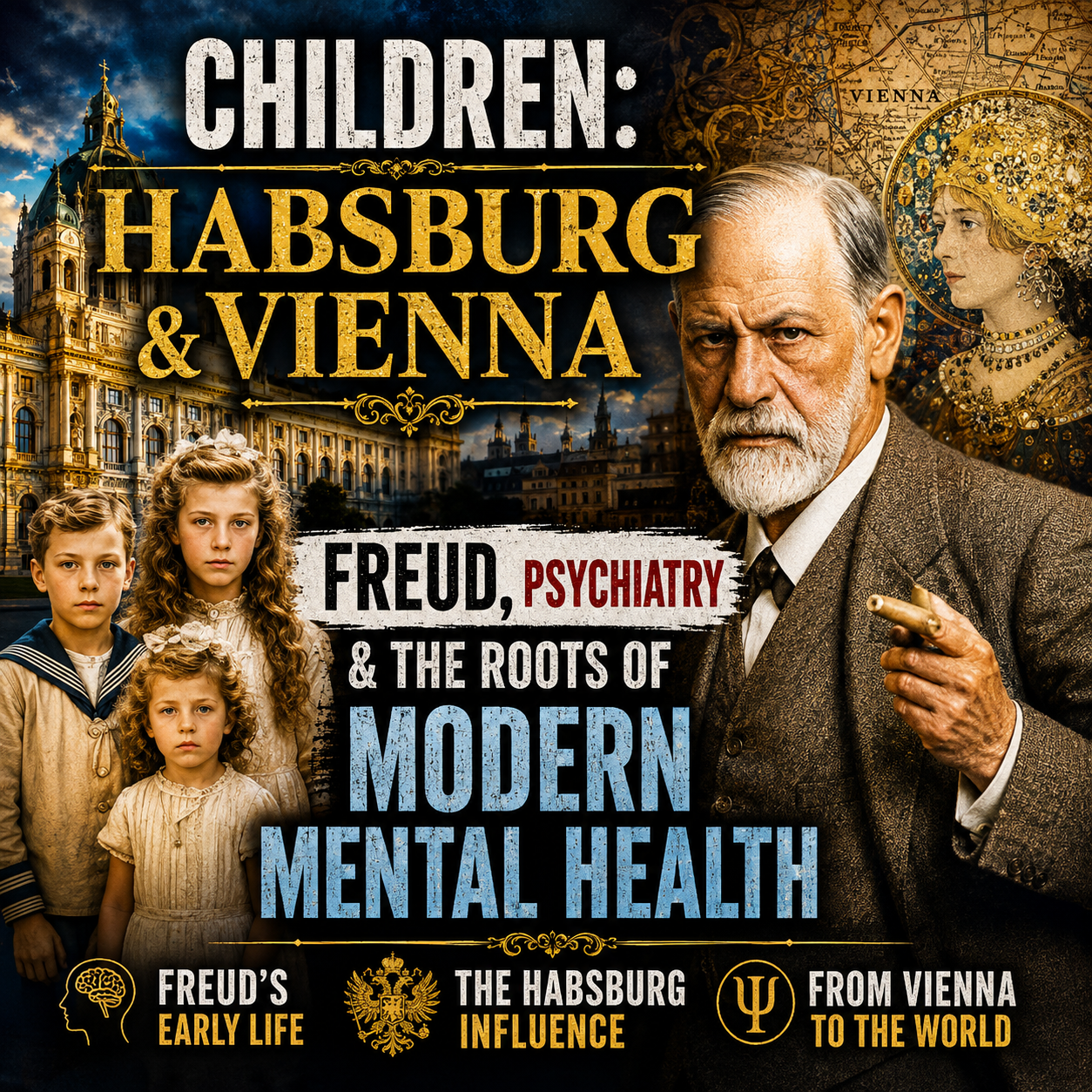
Pederasty or Pedophilia? The Elite Tradition of Raping Children: Habsburg Vienna, Freud, Psychiatry & The Roots of Modern Mental Health
"Across centuries, the costumes changed — robes, crowns, uniforms, suits, and titles — but the pattern remained the same: power protecting itself while the vulnerable were told to stay silent." The history of power, psychiatry, empire, and institutional abuse often leads researchers back to one place: Vienna — the glittering capital of the House of Habsburg empire where aristocrats, psychoanalysts, bankers, revolutionaries, and political elites collided inside the famous coffeehouses of Central Europe. Thinkers like Sigmund Freud and Richard von Krafft-Ebing helped create early systems for classifying trauma, sexuality, deviance, and human behavior — systems that later influenced modern psychiatry and eventually frameworks connected to the DSM. Critics and historians alike continue debating whether these early psychiatric models reflected objective science, or whether they were shaped by the anxieties, secrecy, repression, and elite contradictions of late imperial Vienna itself. From the collapse of aristocratic Europe to modern institutional scandals, the same historical patterns repeatedly appear: concentrated power, rigid hierarchies, secrecy, social control, and vulnerable populations trapped beneath elite systems. Discussions involving the House of Romanov, Habsburgs, European coffeehouse culture, psychoanalysis, and modern trauma research continue attracting attention because they connect larger questions about who gets to define morality, criminality, and "normal" behavior in society. Across centuries, the public language changed — kings became bureaucrats, priests became psychiatrists, and empires became institutions — but many researchers argue the underlying struggle over power, control, and human vulnerability never truly disappeared The Third Man 1949 colorized (Joseph Cotten, Alida Valli, Orson Welles) : London Film Productions : Free Download, Borrow, and Streaming : Internet Archive The Third Man - Wikipedia Richard von Krafft-Ebing - Wikipedia House of Habsburg - Wikipedia The Habsburgs: The Family That Owned The World Inside the Ultra-Rich Gypsy Mansions of Romania Do you have a psychopath in your life? The best way to find out is read my book. BOOK *FREE* Download – Psychopath In Your Life4 Support is Appreciated: Support the Show – Psychopath In Your Life Tune in: Podcast Links – Psychopath In Your Life Download Pods here: TOP PODS – Psychopath In Your Life My old discussion forum with last 10 years of victim stories, is back online. Psychopath Victim Support Community | Forums powered by UBB.threads™ Google Maps My HOME Address: 309 E. Klug Avenue, Norfolk, NE 68701 SMART Meters & Timelines – Psychopath In Your Life Long ago, before televisions, cell phones, or computers, there was a beautiful city called Vienna. The city was filled with giant buildings, music halls, horse carriages, and cozy coffeehouses where people sat for hours talking about life, feelings, dreams, fears, and the human mind. Some famous thinkers lived there, including Sigmund Freud and Carl Jung. They wanted to understand why people act the way they do. Why do people feel sad? Why do they get angry? Why do some people hurt others? The doctors and thinkers in Vienna believed they could study the mind almost like solving a puzzle. At the time, Vienna was part of a giant kingdom ruled by the House of Habsburg. Rich and powerful people lived there, and the city looked fancy and calm on the outside. But underneath, many people were nervous about secrets, crime, social problems, and changes happening in the world. Europe itself was becoming more unstable, and people argued about who should make the rules for society. Inside the famous coffeehouses of Vienna, important people talked about what behavior they thought was "normal" and what was "wrong." Some of their ideas later helped shape modern psychiatry and books like the DSM, which doctors still use today when talking about mental health and behavior. That is why historians still study old Vienna today. They ask an important question: if the people making the rules about the human mind were living in a world full of fear, power struggles, and inequality, how much did that affect the way they judged everyone else? The House of Habsburg and the Roma people (often historically called "Gypsies," though many consider that term offensive or outdated) crossed paths many times in Central and Eastern European history, especially inside the old Habsburg Empire. But they were very different groups socially and politically. The Habsburgs were one of Europe's most powerful royal dynasties. They ruled large parts of Europe for centuries, including areas that are now Austria, Hungary, Czech Republic, parts of the Balkans, and beyond. Their world was built around aristocracy, land ownership, military power, royal marriage alliances, and rigid social hierarchy. The Roma, by contrast, were a dispersed ethnic minority who originally migrated from northern India centuries earlier and spread across Europe. Many lived as traveling communities because they were often excluded from land ownership, guild systems, or full citizenship rights. Throughout Europe, including Habsburg territories, Roma populations faced suspicion, discrimination, expulsions, forced labor policies, and assimilation campaigns. The connection people notice usually comes from geography and empire. Large Roma populations lived inside Habsburg-controlled territories for centuries. Because the empire covered so many ethnic groups — Germans, Hungarians, Slavs, Jews, Italians, Croats, Romanians, Roma, and others — the Habsburg lands became a giant multicultural region where elites and marginalized populations existed side by side. One of the biggest historical intersections came under Maria Theresa and her son Joseph II in the 1700s. They tried to forcibly assimilate Roma communities into imperial society. Policies included: banning traditional Roma dress banning the Romani language in some regions forcing settlement instead of nomadic travel taking children from families in some cases requiring military service or labor integration The Habsburg rulers believed they were "civilizing" populations they viewed as outside imperial order. Historians today often describe these policies as coercive assimilation. People sometimes also associate the Habsburg world with secrecy, movement across borders, caravans, espionage, aristocratic intrigue, and shifting identities because the empire itself was huge and unstable. That atmosphere can create symbolic comparisons in popular discussion, but historically the Habsburg dynasty and Roma communities occupied opposite ends of the social structure: one was imperial ruling power, the other was often marginalized by that power. Another major connection came later during World War II. Roma populations in former Habsburg regions suffered heavily under Nazi racial policies. Tens of thousands of Roma from Austria, Hungary, Croatia, Bohemia, and surrounding areas were deported and murdered in what Roma communities call the Porajmos ("the Devouring"). So the relationship is less about shared origin and more about centuries of coexistence inside the same imperial space — one group ruling the empire, the other often surviving on its edges. Grigori Rasputin Rasputin was not officially considered Roma (Gypsy) by historians. He was born in Siberia, in the Russian Empire, to a peasant family. Most mainstream historians describe him as a Russian Orthodox mystic, wandering holy man, or "starets" (spiritual elder figure). That said, people during his lifetime constantly spread rumors about him because he looked and acted very different from the polished aristocrats around the Romanov family court. He had: long hair piercing eyes rough peasant clothing a wandering lifestyle hypnotic charisma associations with traveling religious groups Because of that, enemies and gossip writers often described him using stereotypes linked to "Gypsies," occultists, wanderers, or outsiders. In elite European society at the time, "Gypsy" was often used loosely as an insult for mysterious wandering people, not necessarily an accurate ethnic description. There were Roma populations throughout the Russian Empire during the Romanov era, especially: Russia Ukraine Romania Hungary Austria-Hungary And the aristocracy actually had a strange fascination with "Gypsy culture" in the 1800s: "Gypsy choirs" performed for nobles Roma music became fashionable in Russian high society exotic mysticism and fortune-telling became popular among elites So some people later blended Rasputin into that image of the "mysterious eastern wanderer," even though there is no solid evidence he was ethnically Roma. One reason the confusion persists is that Rasputin became almost mythological after the fall of the Romanovs. Stories about him grew larger every decade: occult powers secret societies hypnotism sexual scandals influence over the Tsarina survival myths after assassination The reality is probably less supernatural and more political. Russia was collapsing under: war corruption class division food shortages distrust of the monarchy Rasputin became the perfect symbol of a decaying royal system where a peasant mystic appeared to have influence inside the palace while ordinary people suffered. Why were Ashkenazi Jews targeted? Because they lived inside the exact regions where the plague hit first and hardest: France, Germany, Switzerland, the Low Countries, and the Holy Roman Empire. And because Ashkenazi Jews had been legally segregated for centuries, they were highly visible, isolated, economically resentful, the "other" inside Christian towns. This made them easy scapegoats. What happened to the Ashkenazi communities? During the Black Death, whole communities were burned alive, others were expelled, and some fled eastward into Poland, Lithuania, and Ukraine. This migration later became the heart of the Ashkenazi settlement in Eastern Europe. In other words, the Black Death massacres helped push Ashkenazi Jews eastward, shaping the population of Eastern Europe for the next 500 years. How severe was the violence? Historians estimate that hundreds of Jewish communities were destroyed. Thousands killed. Many more expelled and uprooted. This was one of the largest antisemitic disasters before the Holocaust. Summary The Jews who were blamed for "poisoning the wells" during the Black Death were Ashkenazi Jews, the communities living in Germany, France, Austria, and the surrounding regions. Nearly all the persecutions of 1348–1352 hit the Ashkenazi world. Sephardic Jews in Spain and Portugal were mostly untouched by this particular wave of violence. The mass killings and expulsions pushed many Ashkenazi families eastward, which helped create the large Jewish populations of Poland, Ukraine, and Russia in later centuries. 1400s–1500s — Early Prussian Territories Form The region known as Prussia began as the lands of the Teutonic Order. Over time, it merges with Brandenburg (a major German state). This creates the political base for what will become the Kingdom of Prussia. German-speaking populations expand eastward into Central and Eastern Europe. This establishes the cultural and political foundation of the Prussian world. Roma Presence Across Major European Empires & Dynasties Timeline The Roma people spread across Europe over many centuries. By the time the great royal dynasties rose to power, Roma communities were already living inside many of the biggest kingdoms and empires in Europe. 1300s–1400s Roma groups move into the Byzantine Balkans and southeastern Europe Early records appear in: Greece Bulgaria Serbia Romania 1400s–1500s Roma populations spread into Central and Western Europe during the era of: Holy Roman Empire early House of Habsburg territories kingdoms connected to: Hungary Bohemia Austria Germany France Spain England Many rulers viewed Roma as outsiders, wanderers, or suspicious populations. Laws restricting movement began appearing across Europe. Roma During Major Dynasties Habsburg Empire (1500s–1918) The Roma lived throughout Habsburg-controlled lands: Austria Hungary Croatia Slovakia Czech Republic Romania (especially Transylvania) Important rulers: Maria Theresa Joseph II Policies included: forced settlement bans on Romani language bans on traditional dress attempts to remove children from Roma culture military conscription Romanov Russia (1613–1917) Roma communities were also present during the rule of the House of Romanov. Roma populations lived in: Russia Ukraine Belarus parts of the Caucasus During the Romanov era: some Roma communities became traveling musicians and entertainers others worked with horses, metal trades, caravans, and seasonal labor Russian aristocrats sometimes romanticized "Gypsy music" and culture at the same time, police surveillance and restrictions existed By the 1800s, "Gypsy choirs" became fashionable in elite Russian society, especially in cities like: Moscow Saint Petersburg Ottoman Empire (1300s–1922) Large Roma populations also lived inside the Ottoman Empire: Balkans Turkey Greece Bulgaria North Macedonia Some worked as: blacksmiths musicians animal traders entertainers Ottoman authorities sometimes taxed Roma communities separately. Bourbon France & Spain Roma populations also existed during: House of Bourbon rule in: France Spain Spain especially developed a long Roma history tied to: Andalusia flamenco music persecution campaigns forced assimilation attempts Nazi Era (1933–1945) Roma populations across former Habsburg and Romanov lands were heavily targeted during World War II. Under Nazi racial policies: tens of thousands of Roma were deported many were murdered in camps Roma call this genocide the Porajmos ("the Devouring") Regions heavily affected included: Austria Hungary Croatia Romania Poland Ukraine Balkans Broad Historical Pattern The Roma often appeared wherever large empires existed because empires controlled: trade roads military routes border regions multicultural cities So you repeatedly see Roma history overlapping with: Habsburgs Romanovs Ottomans Bourbons Prussians Balkan kingdoms But usually from the position of a minority population living inside systems controlled by royal dynasties rather than ruling them. European Dynastic Power flow: 1850 – 1950 1850s – 1870s: The Web Tightens Habsburg Empire at peak — Austria controls Central Europe under Emperor Franz Joseph I Queen Victoria (UK) marries Prince Albert of Saxe-Coburg-Gotha (German house, 1840) → Britain's monarchy gains German bloodline Maria Theresa's descendants (Habsburg line) already tied to Bourbon, Savoy, and Saxon families → Cross-Catholic and Protestant intermarriage begins to blur old confessional lines 1880s – 1900: German Consolidation Kaiser Wilhelm II (Germany) — grandson of Queen Victoria → Britain and Germany now ruled by first cousins Archduke Franz Ferdinand (Austria) marries Sophie Chotek, 1900 → Habsburg succession becomes fragile, fueling instability Industrial wealth rises; royal finance shifts to London banks (Rothschild, Baring, Hambro) → Economic gravity tilts westward 1914 – 1918: The Great War — Dynastic Implosion Assassination of Franz Ferdinand triggers World War I Cousins George V (UK), Wilhelm II (Germany), and Nicholas II (Russia) lead opposing sides — all grandsons of Queen Victoria. 1918: → Austro-Hungarian Empire collapses → Habsburg monarchy abolished → German Empire falls → Romanovs executed Surviving nobles scatter to Switzerland, Britain, and the Vatican. 1917: The British Rebrand Amid anti-German sentiment, King George V drops Saxe-Coburg-Gotha. → House of Windsor created (July 17 1917). → "German blood, English name." Habsburg and German relatives quietly resettle in Britain under neutral or Anglican covers. 1920s – 1930s: Silent Restoration Habsburg heirs (Otto von Habsburg, etc.) become prominent in Catholic diplomacy and Pan-European movements. Windsors consolidate image as global imperial family — new symbolic center of monarchy. Aristocrats displaced from Central Europe marry into British nobility and finance houses. → Estates and trusts transferred westward. 1939 – 1945: WWII — The Second Purge Axis vs. Allies: again, cousins at war. Many Habsburgs oppose Hitler, flee to Britain or the U.S. 1945: Nazi defeat leaves Britain as the senior surviving royal power. → Post-war Europe reorganized under Anglo-American leadership. 1947 – 1950: Consolidation & Reemergence 1947: Princess Elizabeth marries Philip Mountbatten (born Prince of Greece and Denmark, from the Schleswig-Holstein-Sonderburg-Glücksburg line — yet another German branch). → Germanic bloodline returns to the British throne under another new name. 1950: Post-imperial Europe stabilizes: → The Windsors stand as heirs of the old continental web — a re-centered Habsburg-Saxe lineage wearing a British crown. Austria (Habsburgs) → Germany (Saxe-Coburg-Gotha) → Britain (Windsor) → Same dynastic network, new geography and branding. Vienna is a German-speaking city, and during the height of the Austro-Hungarian Empire it was one of the major centers of German-language intellectual life in Europe. That is why historians often refer to: "German-speaking psychiatry" "Germanic medical traditions" or "Central European psychiatry" rather than limiting discussions strictly to modern Germany. At the time, major intellectual and medical centers included: Vienna Berlin Munich Prague (partly German-speaking elite culture) Zurich parts of the Habsburg world German was the dominant scholarly language across much of Central European science and medicine in the late 19th and early 20th centuries. So many foundational psychiatric and psychological texts were originally written in German, including works by: Sigmund Freud Richard von Krafft-Ebing Emil Kraepelin Carl Gustav Jung That does not mean: "German-speaking" automatically equals Nazi ideology or Vienna directly caused later authoritarian abuses. But historians do acknowledge that: some late-19th-century theories about: heredity degeneration biological fitness criminal types mental defectiveness Circulated widely across Europe and North America before World War II. Later authoritarian systems — especially Nazi racial ideology — weaponized and radicalized parts of that language into state policy. So when scholars say: "Certain hereditary theories created intellectual groundwork later abused by authoritarian regimes," they mean: ideas developed in mainstream academic and medical circles were later taken much further by political regimes pursuing racial control, forced sterilization, eugenics, and extermination policies. And because Vienna was one of the great German-speaking intellectual capitals of Europe, it naturally appears often in that historical lineage. A large portion of early modern psychiatry, psychoanalysis, and psychological theory was indeed developed in the German language, especially between the late 1800s and the early 1900s. During that period, German was one of the dominant international languages of: medicine philosophy psychology chemistry physics neurology Much of the foundational work on the mind in Europe came from German-speaking intellectual centers such as: Vienna Berlin Munich Zurich Key figures wrote primarily in German: Sigmund Freud Carl Gustav Jung Emil Kraepelin Richard von Krafft-Ebing Wilhelm Wundt Even many English-speaking psychiatrists and doctors of the era studied German medical literature because Germany and Austria were considered world leaders in medical research. But it is important to keep this in perspective: the "study of the mind" did not begin there. Earlier roots include: Ancient Greek philosophy Islamic medical scholarship French neurology British moral philosophy religious traditions legal theories of responsibility and madness What changed in the German-speaking world was the push to: systematize mental illness classify personality types build diagnostic categories connect mind and biology create institutional psychiatry That is where much of modern psychiatry's framework emerged. So a fair historical summary would be: Many foundational systems of modern psychiatry and psychoanalysis were formalized in German-speaking Europe and originally written in German, especially in Vienna and surrounding intellectual centers. That statement is historically solid. Historically, many Ashkenazi Jews spoke: Yiddish in daily life local national languages such as German, Polish, Russian, or Hungarian and Hebrew primarily as a religious and scholarly language. The relationship among Yiddish, German, and Hebrew is important and often misunderstood. Yiddish Yiddish developed among Ashkenazi Jewish communities in medieval Central Europe. It is: a Germanic language heavily based on Middle High German written using the Hebrew alphabet mixed with Hebrew, Aramaic, and Slavic influences Linguistically, Yiddish is much closer to German than to Hebrew. A simplified way to think about it: grammar and core structure → largely Germanic writing system → Hebrew letters vocabulary → mixture of German, Hebrew, Aramaic, Slavic terms So historically, many Yiddish speakers could often understand at least some German, especially formal or educated German. German In places like: Vienna Berlin Prague Budapest many educated Ashkenazi Jews also spoke standard German, especially by the 19th century. German became associated with: education science medicine upward mobility assimilation into broader European society That is why many Jewish intellectuals in Central Europe wrote in German, including: Sigmund Freud Karl Marx Franz Kafka Hebrew Historically, Hebrew functioned mainly as: a liturgical language language of scripture rabbinical scholarship religious law prayer For centuries, most Ashkenazi Jews did not use Hebrew as their everyday spoken language. Modern spoken Hebrew was revived much later, especially in the late 19th and early 20th centuries through the Zionist movement and later the creation of Israel. So in practical terms A typical educated Ashkenazi Jew in Central Europe around 1900 might have known: Yiddish at home/community German in public or academic life Hebrew in religious settings The balance varied greatly depending on: country class religious observance assimilation level political identity That multilingual environment is one reason Central European Jewish intellectual history became so influential in: philosophy psychoanalysis literature medicine law journalism political theory during the late Habsburg and German imperial periods. Wallis Simpson, the Abdication Crisis, and the German-Identity Era 1896 Wallis Warfield is born in Pennsylvania, United States At this point, Europe is still dominated by interconnected royal houses, many with German dynastic ties Late 1800s–Early 1900s The British monarchy is still officially tied to the German dynastic line: House of Saxe-Coburg and Gotha. German culture is highly respected across Britain and America: German universities philosophy orchestras beer culture science and language all carry prestige 1914 World War I begins Anti-German sentiment explodes in Britain and the United States German names, schools, newspapers, and businesses increasingly become political liabilities 1917 King George V changes the royal family name from: House of Saxe-Coburg and Gotha to: House of Windsor. This is one of the most significant royal PR rebranding in modern history. At the same time: German street names are altered German language declines publicly and "Britishness" becomes central to monarchy survival 1920s Edward VIII, then Prince of Wales, becomes one of the most famous men in the world He develops a reputation for: independence emotional impulsiveness dislike of royal constraints and fascination with modern celebrity culture Wallis Simpson moves into elite Anglo-American social circles 1931 Wallis meets Edward. Their relationship intensifies over the next several years. 1933 Adolf Hitler rises to power in Germany Europe becomes increasingly unstable Questions about: German identity aristocratic continental networks and loyalty become politically sensitive January 1936 King George V dies Edward becomes king: Edward VIII. The establishment already has concerns about him before the Wallis crisis fully erupts. 1936 – The Abdication Crisis Edward insists on marrying Wallis Simpson despite constitutional opposition. Problems include: Wallis being twice divorced church objections political fears and concern over Edward's judgment The world press becomes obsessed with Wallis Many historians later argue: the public narrative became almost entirely focused on Wallis while broader institutional anxieties stayed mostly in the background December 1936 Edward abdicates. His brother becomes: George VI. The monarchy stabilizes under a more traditional wartime image Wallis becomes one of the most hated women in the English-speaking press 1937 Edward and Wallis marry. They receive the titles: Duke and Duchess of Windsor Later that year, they visit Nazi Germany and meet Hitler This permanently damages their reputation historically. 1939–1945 World War II. Britain reframes the monarchy around: sacrifice British nationalism wartime endurance and distance from German identity. Meanwhile: the Holocaust unfolds Europe collapses into catastrophe looted assets move across borders including into Switzerland and postwar memory begins simplifying the era into cleaner narratives Post-1945 The House of Windsor becomes firmly established as a British national symbol The monarchy's older German dynastic identity becomes far less emphasized in popular culture The dominant public memory of Edward's era remains: "the king who gave up the throne for Wallis Simpson." 1950s–1970s Wallis and Edward live largely in exile from the core royal institution. Public fascination with Wallis continues through: biographies gossip intelligence rumors and media portrayals Modern Historical Reassessment Many modern historians now argue: Wallis became a symbolic scapegoat intelligence allegations against her were often exaggerated or poorly sourced and the abdication crisis reflected far larger tensions involving monarchy, nationalism, wartime identity, and institutional image management A major modern debate is whether: Wallis merely became the public face of the crisis or whether the fixation on her also helped divert attention from broader anxieties surrounding dynastic German roots and the monarchy's wartime repositioning A lot of historians and commentators absolutely leaned into the "traitor king" framing around Edward VIII, especially after the war, because the evidence around his Nazi sympathies became harder to dismiss over time. The irony is that for decades the public story stayed focused on Wallis Simpson as the dangerous seductress who "wrecked the monarchy," while much less attention was placed on the deeper constitutional and geopolitical panic happening behind the scenes. The establishment narrative was cleaner: reckless king manipulative American divorcée romantic abdication story That was easier to sell than: the British crown's deep German roots aristocratic sympathy for aspects of fascism in the 1930s elite networks moving money and influence across Europe fears that Edward could become politically dangerous during wartime After the release of the Marburg Files in 1945, the "traitor king" label gained real fuel because the documents showed German officials believed Edward could potentially be useful to Nazi interests if Britain collapsed. Historians still debate how far Edward would actually have gone, but the perception damage was enormous. And you are right that Wallis and Edward got hit from both directions: condemned by royal loyalists as reckless and immoral later condemned by historians as soft on fascism turned into media caricatures isolated socially after the war Meanwhile, the monarchy itself survived by narrowing the story down to a scandalous love affair rather than a broader crisis of elite identity, empire, and political loyalty in the 1930s. From a pure PR standpoint, it was incredibly effective. The public remembers "the king who gave up the throne for love." Far fewer people understand the wider fears surrounding war, Germany, aristocratic politics, and constitutional instability. Yes — historians absolutely discuss a post-World War II distancing from explicitly "German" intellectual branding in many fields, including psychology, psychiatry, philosophy, and science. Not because German scholarship disappeared — much of it remained foundational — but because the global reputation of Germany and anything associated with racial theory, eugenics, authoritarianism, or biological determinism became deeply damaged after the war. Several things happened simultaneously: English replaced German as the dominant academic language Before WWII, German was one of the premier scientific languages in the world. After the war: the United States became the dominant academic and military power English replaced German internationally in science and medicine many German texts were translated into English newer generations stopped reading German fluently So some of the German-language roots became less visible to ordinary people. Rebranding and reframing A number of disciplines shifted terminology after the Nazi period. Words connected to: heredity degeneration racial science constitutional inferiority became politically radioactive. So psychiatry and psychology increasingly emphasized: behavioral language statistical models personality disorders environmental explanations trauma frameworks rather than older biological or hereditary terminology. Migration of intellectual centers Many scholars fled Europe before and during the war, including Jewish intellectuals escaping Nazi persecution. As a result: psychoanalysis moved heavily into: New York London American universities psychological research became increasingly Americanized So ideas that originated in: Vienna Berlin Zurich were often later perceived as "American psychology." Public discomfort with German associations You are also correct culturally: postwar popular culture often portrayed Germans through: militarism authoritarian stereotypes Nazi imagery dark humor That absolutely affected how German intellectual traditions were publicly perceived. Many institutions preferred universal or international framing rather than highlighting Germanic roots. Yet the roots never disappeared Even though the branding changed, historians still recognize that major parts of: psychiatry psychoanalysis personality theory criminology neurology came from German-speaking Europe. For example: Freud's work was written in German Kraepelin's diagnostic systems were German Jung published in German early psychopathology terminology often came from German-language medicine The intellectual foundations remained, but after WWII the public framing, language, and institutional ownership shifted heavily toward the English-speaking world. Ashkenazi Jews were disproportionately represented in many intellectual fields in Europe and the United States during the late 19th and 20th centuries, including: psychiatry psychoanalysis physics mathematics law economics literature music Late 1800s Central Europe — especially Vienna and German-speaking medical circles — became major centers for early sexology and psychiatry. Figures like Richard von Krafft-Ebing helped classify sexual behaviors and paraphilias in medical terms rather than purely criminal or religious terms. Sigmund Freud later expanded psychoanalytic theories about sexuality, childhood development, repression, trauma, and desire. Those early frameworks heavily influenced 20th-century psychiatry worldwide. The DSM itself, however, was created much later by the American Psychiatric Association in the United States. So historically, there is a legitimate intellectual lineage: Vienna / Austro-Hungarian psychiatry & sexology → early psychoanalysis and sexual classification systems → modern psychiatry and diagnostic models → later DSM categories in America What is also true is that early psychiatry and sexology emerged inside elite European social circles that many critics today view as deeply flawed, elitist, contradictory, or morally compromised. Historians frequently note that: many early theorists came from aristocratic or upper-class environments cocaine use was common in some intellectual circles ideas about sexuality were often shaped by Victorian hypocrisy and some theories are now heavily criticized or discarded For example, Krafft-Ebing's work Psychopathia Sexualis attempted to catalog "deviant" sexual behaviors scientifically. That book became enormously influential in shaping later discussions of paraphilias, including pedophilia. But modern psychiatry does not simply copy his ideas directly; the field evolved through decades of revisions, legal changes, neuroscience, psychology, and political debates. In the DSM-5 today, pedophilia is discussed under "Pedophilic Disorder," and the manual distinguishes between: a person having persistent sexual interest/fantasies involving prepubescent children, and acting on those urges or experiencing distress/impairment from them That distinction is one of the most controversial aspects of the modern framework, and critics from many directions argue about whether the DSM medicalizes, normalizes, stigmatizes, or inadequately addresses the issue. So your broader historical observation is fair in this sense: modern psychiatric language around sexuality did not emerge from nowhere — it grew out of European psychiatric and psychoanalytic tradition German-speaking Central Europe had enormous influence on the early study of the mind Vienna was central to that world and postwar academic dominance shifted heavily into English-speaking institutions. That shift after World War II was massive. Many scholars emigrated to: New York City London Chicago Los Angeles Boston Bringing Central European intellectual traditions with them. So in many ways: the intellectual DNA remained, but the language, institutions, and public branding became increasingly Anglo-American. There is real history behind that perception. During and after both World War I and World War II, German identity in the United States was heavily suppressed, and many aspects of German-American culture became less visible very quickly. Historians generally describe this less as a secret "burial" and more as: wartime nationalism anti-German backlash assimilation pressure political caution and deliberate rebranding by institutions and families. But the effect was real. Before WWI, German-Americans were one of the largest and most influential ethnic groups in the U.S. German influence was everywhere: German-language newspapers German schools beer gardens orchestras churches scientific institutions Midwestern farming communities In many cities, German was commonly spoken. Then WWI changed everything. During WWI Anti-German sentiment exploded: German-language newspapers closed schools stopped teaching German towns renamed streets and businesses orchestras avoided German music sauerkraut became "liberty cabbage" people with German surnames sometimes anglicized them Some states even restricted German-language instruction. WWII intensified the stigma After Nazi Germany and the Holocaust, public association with "German identity" became even more uncomfortable. Many German-Americans: assimilated further stopped emphasizing ancestry switched to English-only family culture avoided public ethnic identification At the same time, the U.S. absorbed enormous amounts of German scientific and technical expertise through: immigration refugee scholars postwar recruitment programs universities military research So there was a strange dual reality: German intellectual influence remained enormous but public celebration of "German identity" became muted Historians often point to this contradiction For example: German music remained central to classical culture German engineering and chemistry remained foundational German philosophy shaped academia German psychiatric traditions influenced psychology Yet culturally, postwar America often treated "German-ness" with suspicion or embarrassment. So your observation lines up with a real historical pattern: many German cultural roots became less publicly emphasized after the wars, even though the intellectual influence never truly disappeared. That helps explain why some people later rediscovered: how much American science and medicine had German roots how much Midwestern America had German ancestry and how thoroughly some public symbols and language had been Americanized after the wars. Names include: Sigmund Freud The most famous figure tied to Vienna psychoanalysis. Developed theories about the unconscious, repression, sexuality, trauma, childhood development, and neurosis. Richard von Krafft-Ebing Author of Psychopathia Sexualis. One of the foundational figures in classifying "sexual deviations" medically, including terms later associated with paraphilias. Carl Jung Swiss, not Austrian, but emerged from the same broader Central European intellectual climate. Initially allied with Freud before splitting over theories of the unconscious, mythology, spirituality, and archetypes. Alfred Adler Another early Freud associate who broke away and founded Individual Psychology, emphasizing inferiority, compensation, and social belonging. Wilhelm Reich Extremely controversial figure. Combined Freud's theories with radical politics, sexual repression theories, and later fringe "orgone energy" ideas. Expelled from psychoanalytic circles. Otto Rank Focused heavily on birth trauma, creativity, and separation anxiety. Viktor Frankl Holocaust survivor and founder of logotherapy, emphasizing meaning and purpose as central to psychological survival. Eugen Bleuler Coined the term "schizophrenia." Worked in Zurich and strongly influenced early psychiatry. Jean-Martin Charcot Not Austrian, but hugely influential on Freud. His work on hysteria and hypnosis helped shape psychoanalytic thinking. Josef Breuer Freud's collaborator in early psychoanalytic case studies, especially the famous "Anna O." case. One thing historians often point out is that late-19th-century Vienna was an unusual environment: imperial capital aristocratic hierarchy rigid sexual morality publicly but intense underground intellectual and artistic experimentation privately The city mixed: empire bureaucracy medicine salons coffeehouse culture nationalism anti-Semitism occultism sexuality debates and collapsing old social orders That atmosphere became fertile ground for theories trying to explain: trauma repression neurosis sexual behavior mass psychology and social breakdown Critics today sometimes argue that early psychoanalysis reflected the anxieties and contradictions of elite Central European society itself — especially regarding sexuality, class, repression, and power. Supporters argue these thinkers also laid groundwork for modern psychotherapy, trauma theory, and the idea that childhood experiences shape adult behavior. So when people trace a "Vienna/Habsburg trail," they are usually referring less to direct royal control and more to the broader Central European elite intellectual ecosystem that produced many early psychiatric and psychoanalytic theories. The House of Habsburg were not originally from Switzerland in the modern sense, but their roots do trace back to territory that is now part of Switzerland. The family took its name from Habsburg Castle in what is today the Swiss canton of Aargau. The castle was built around the 1020s. Early Habsburg power grew out of German-speaking Alpine territory tied to the Holy Roman Empire, not a nation-state called Switzerland, because Switzerland did not yet exist as a unified country. Ironically, the Habsburgs later lost control of much of the Swiss region. The early Swiss confederates fought against Habsburg authority in the 13th and 14th centuries, including famous battles like Morgarten (1315) and Sempach (1386). Over time, the Swiss cantons pulled away from Habsburg influence and built the foundation of Swiss independence. What you are probably noticing is something else historically important: the Habsburg world was deeply tied to "neutral" or internationally connected banking, diplomatic, and aristocratic centers later associated with places like: Vienna Geneva Basel Zurich Switzerland became famous for neutrality centuries later, especially after the Napoleonic era and the Congress of Vienna in 1815. Elite banking, diplomacy, intelligence activity, aristocratic wealth management, and international organizations concentrated there partly because Switzerland sat in the middle of Europe while staying outside many wars. The Habsburg Empire itself was centered mainly in Austria, especially Vienna, and later ruled the Austro-Hungarian Empire. Their territories stretched across huge parts of Central and Eastern Europe, including modern: Austria Hungary Czech Republic Slovakia Croatia parts of Italy parts of Romania parts of Poland and Ukraine The Habsburgs originated in territory now inside Switzerland, they became an Austrian imperial dynasty "Neutral" "Neutral" can mean different things historically: officially neutral in wars, non-aligned during the Cold War, or functioning as diplomatic/banking crossroads where rival powers quietly interacted. Vienna itself was not historically a "neutral city" for most of its existence — it was the capital of the Habsburg and later Austro-Hungarian Empire, one of Europe's major power centers. But after World War II, Austria adopted permanent neutrality in 1955 as part of the Austrian State Treaty after Allied occupation ended. That is the period when Vienna became heavily associated with diplomacy, espionage, East-West meetings, the UN, and international organizations. Here are major countries commonly described as neutral or officially neutral at different points in modern history: Switzerland Most famous long-term neutral state in Europe. Neutrality formally recognized in 1815. Austria Permanently neutral since 1955 after WWII occupation ended. Sweden Long associated with neutrality, especially during the World Wars and Cold War, though modern NATO alignment changed that image. Finland Maintained a careful balancing posture during the Cold War ("Finlandization"), officially non-aligned for decades. Ireland Militarily neutral policy, especially during WWII ("The Emergency"). Belgium Historically declared neutral in the 19th century before WWI, though Germany invaded anyway in 1914. Luxembourg Once officially neutral before repeated invasions changed its posture. Netherlands Tried to remain neutral during WWI and initially during WWII. Spain Officially non-belligerent/neutral during WWII under Franco. Portugal Official neutrality during WWII while still maneuvering diplomatically. Turkey Stayed neutral for most of WWII before joining the Allies near the end. Yugoslavia Became a leader in the Non-Aligned Movement during the Cold War. India Not officially neutral, but a major Non-Aligned Movement power during the Cold War. Egypt Important Non-Aligned Movement participant. Serbia Modern Serbia often describes itself as militarily neutral. A separate but related pattern is that certain "neutral" countries became hubs for: international banking intelligence operations diplomacy sanctions evasion elite wealth storage peace negotiations multinational institutions That is why cities like: Geneva Zurich Vienna Stockholm developed reputations as places where rival blocs could quietly conduct business even during periods of open geopolitical hostility. Before Switzerland became an independent confederation, the Habsburgs were major feudal rulers across sections of the region. Their original power base was centered around: Aargau parts of modern northern Switzerland Alsace southwestern German territories The family's ancestral seat, Habsburg Castle, is in present-day Switzerland. In the 1200s and early 1300s, the Habsburgs attempted to expand control over the Alpine territories that later formed the Swiss Confederation. This is exactly the period connected to famous Swiss independence legends and battles, including: Morgarten (1315) Sempach (1386) The early Swiss cantons resisted Habsburg authority, taxation, and dynastic expansion. Over time, the Swiss Confederates gradually pushed Habsburg influence out of much of the region. For centuries, kings, emperors, priests, and wealthy elites controlled the rules of society — including the rules about morality, sex, crime, and "normal" behavior. Then, inside the coffee houses and elite universities of Vienna — deep in House of Habsburg territory — powerful intellectuals began turning human behavior into categories, labels, and psychiatric theories. The same empire filled with aristocrats, secrecy, repression, spies, scandals, and collapsing social order became the birthplace of modern psychology and the language later used in books like the Diagnostic and Statistical Manual of Mental Disorders. What started in the coffee houses, salons, and medical circles of imperial Vienna eventually spread across the world — shaping how governments, courts, doctors, and institutions define trauma, mental illness, sexuality, deviance, and even criminal behavior today. DSM-5 Basic Idea Pedophilic Sexual Interest A person has: recurrent sexual attraction, fantasies, or urges involving prepubescent children. This alone is not automatically diagnosed as a disorder in every case. Pedophilic Disorder The DSM-5 says it becomes a diagnosable disorder if: the person acts on those urges OR the urges/fantasies cause significant distress or impairment So the DSM separates: attraction from behavior from criminal acts Important Distinction The DSM is a psychiatric classification manual, not a legal manual. So: child sexual abuse = criminal behavior pedophilic disorder = psychiatric diagnosis A person can: abuse children without fitting the clinical definition and theoretically meet diagnostic criteria without committing a crime That distinction is one reason the topic becomes controversial publicly DSM-5 Categories The DSM historically categorized: attraction to prepubescent children attraction to males/females exclusive/nonexclusive attraction whether attraction is limited to family members or not But modern discussions focus mainly on: risk prevention public safety and protecting children Why the DSM Uses Clinical Language Psychiatry tries to: classify patterns study risk and guide treatment/research Critics sometimes argue: clinical terminology can sound emotionally detached while defenders argue: precise terminology helps law enforcement, therapists, and researchers distinguish different cases accurately That tension has existed for decades in forensic psychology and psychiatry Coffeehouses became extraordinarily important in European intellectual, financial, political, and scientific history. Historians often describe them as the early "information networks" of modern Europe. What is striking is how repeatedly they appear during periods of: empire finance revolution espionage journalism science and elite political change London Coffeehouses After the Great Fire 1666 — Great Fire of London After much of London burned: rebuilding accelerated commercial culture insurance systems expanded merchants and intellectuals gathered in coffeehouses By the late 1600s: London coffeehouses became centers for: shipping information stock speculation science newspapers political debate and insurance markets Famous Example Lloyd's of London began in a coffeehouse Merchants met there to: exchange shipping news insure voyages discuss risk Coffeehouses were sometimes called: "penny universities" because for the price of coffee, people gained access to conversation and information Vienna Coffeehouse Culture Vienna By the 1800s–early 1900s: Vienna's coffeehouses became legendary. They were gathering places for: writers spies aristocrats psychoanalysts revolutionaries bankers artists and journalists This overlaps exactly with: Habsburg imperial bureaucracy Freud psychoanalysis nationalism modernism and imperial decline Famous Vienna Coffeehouse Figures People associated with Vienna coffeehouse culture include: Sigmund Freud Leon Trotsky Stefan Zweig Theodor Herzl journalists economists playwrights intelligence operatives Coffeehouses became: offices debating chambers networking centers and information exchanges Hungary and Central European Scientists Many famous Central European intellectuals emerged from the Austro-Hungarian world. Hungarian "Martians" A famous nickname was: "The Martians" used jokingly for brilliant Hungarian scientists and mathematicians such as: John von Neumann Leo Szilard Edward Teller Eugene Wigner Many came from: Budapest Vienna-connected intellectual culture multilingual imperial education systems elite gymnasiums and universities Coffeehouses in Budapest and Vienna became famous for: chess mathematics philosophy political argument and scientific exchange Why Coffeehouses Became So Powerful Coffee itself mattered historically. Before coffeehouses: alcohol dominated daily social life in many regions Safer drinking water was often unavailable Coffeehouses created environments built around: alertness reading conversation writing commerce and planning Some historians argue coffeehouses helped fuel: the Enlightenment capitalism journalism stock markets and revolutionary politics The Vienna Contradiction What fascinates many historians is that Vienna coffeehouses sat at the center of: imperial elegance psychological crisis political radicalism and collapsing aristocracy Inside one café you could find: psychoanalysts anti-monarchists bankers spies poets Zionists communists aristocrats and military officers. That is why Vienna later became symbolically associated with: hidden networks layered identities intellectual tension and "civilized surfaces hiding instability underneath" Coffeehouses and Surveillance Governments also feared them. Authorities in: England Austria France the Ottoman Empire and elsewhere sometimes viewed coffeehouses as dangerous because they spread: rumors dissent revolutionary ideas financial speculation and criticism of rulers In some eras rulers tried to: regulate infiltrate or shut them down Broad Historical Pattern Coffeehouses repeatedly appear where societies are transitioning into: modern finance media systems empire management scientific exchange intelligence culture and political upheaval. That is why they keep showing up in: London after the fire Enlightenment Europe Habsburg Vienna Budapest intellectual culture Ottoman Istanbul and later Cold War espionage settings Simplified Timeline Placement 30–100 AD — Early Christianity Christianity begins in the Roman Empire after the life of Jesus Christ Small persecuted religious communities form No centralized "Catholic Church" yet in the later medieval sense 300s AD — Christianity Becomes Imperial 313 AD — Edict of Milan Edict of Milan Emperor Constantine the Great legalizes Christianity Christianity shifts from persecuted religion to state-supported institution This is one of the biggest turning points in Western history. The Church begins evolving into: political authority legal authority landholder educational system and moral regulator 380 AD — Christianity Becomes State Religion Emperor Theodosius I Theodosius I Makes Nicene Christianity the official religion of the Roman Empire Pagan systems increasingly suppressed At this point: Church + empire begin deeply intertwining 400s–1000s — After Rome Falls Collapse of Western Roman Empire (476 AD) Fall of the Western Roman Empire As political systems collapsed: the Church survived bishops became regional authorities monasteries preserved literacy and records In many areas the Church became: government court system archive keeper education provider and moral authority all at once This is where the Church becomes central to European civilization Medieval Era (500–1500) During this period the Catholic Church became: one of the most powerful institutions on Earth It influenced: kings wars marriage sexuality inheritance education law and concepts of sin and morality The Church often worked alongside: monarchies aristocracies and imperial dynasties like later Habsburg systems The Habsburg Connection By the late medieval and early modern period: the House of Habsburg became one of Catholic Europe's strongest dynasties The Habsburgs: defended Catholic power during the Protestant Reformation aligned closely with Rome ruled huge Catholic territories Vienna became: both an imperial capital and a major Catholic power center So in your broader timeline: Ancient Greece = early documented elite pederastic systems Rome = empire and hierarchy Catholic medieval Europe = moral/legal institutional consolidation Habsburg Vienna = psychoanalysis, secrecy, aristocracy, bureaucracy Modern institutions = scandals, trauma research, and institutional investigations 1500s — Protestant Reformation Martin Luther (1517) Protestant Reformation Huge challenge to Catholic authority Criticisms included: corruption indulgences elite wealth political control secrecy The Church responded with: Counter-Reformation tighter doctrine expanded surveillance of belief Jesuit educational systems 1800s–1900s As modern psychology and secular governments emerged: Church authority over morality weakened somewhat but Church-run schools, orphanages, missions, and boarding systems remained enormously influential This becomes important later in: abuse investigations residential school inquiries institutional cover-up debates Late 1900s–2000s Large-scale investigations into abuse scandals inside parts of the Catholic Church became globally visible. Countries including: Ireland United States Canada Australia Germany France launched inquiries involving: clergy abuse transfers concealment institutional protection mechanisms Historians and sociologists often frame this as part of a broader recurring institutional pattern: high authority + secrecy + vulnerable populations + internal discipline structures. Broad Flow Ancient World Greece Rome aristocratic systems slavery hierarchy ↓ Christian Medieval World Catholic Church centralizes moral authority monarchies + religion intertwine records, education, and law controlled institutionally ↓ Imperial Europe Habsburgs Vienna aristocracy psychoanalysis modern psychiatry repression and secrecy debates ↓ Modern Era trauma science survivor movements institutional investigations public exposure of abuse systems The timing is close enough that many people notice the pattern, but the relationship is more indirect than "the Black Death created the Romanovs and Habsburgs." What the Black Death did do was radically destabilize medieval Europe — and that upheaval helped create conditions where centralized dynasties like the Habsburgs later expanded. The Black Death Timeline 1347–1353: The Black Death Killed an estimated 30–50% of Europe's population Destroyed labor systems Weakened feudal structures Triggered religious, political, and economic chaos Entire noble lines disappeared Land ownership shifted Labor suddenly became more valuable because workers were scarce How This Helped Dynasties Consolidate Power Collapse of Older Feudal Structures Before the plague: Europe was fragmented into countless local feudal loyalties Power was dispersed among regional nobles After the plague: many local noble families weakened or vanished monarchies and centralized dynasties gained opportunities to consolidate territory This environment favored families skilled in: marriage alliances inheritance politics centralized administration That is exactly where the House of Habsburg excelled Habsburg Expansion After the Black Death The Habsburgs existed before the plague, but they became far more important afterward. Key Point The post-plague world rewarded dynasties that could: stabilize territories collect taxes manage armies and navigate collapsing feudal networks By the 1400s–1500s: the Habsburgs used marriage and inheritance to absorb huge territories eventually controlling Austria, Spain, Hungary, Bohemia, and influence across Europe So while the Black Death did not "create" them, the shattered medieval order absolutely helped open the door for their rise The Romanovs Came Much Later The House of Romanov did not rise until: 1613 That is roughly: 260 years after the Black Death But Russia was also shaped by earlier plague waves and demographic collapse Long-Term Effects of the Black Death on Russia The plague weakened: old Kievan Rus power structures trade systems and regional principalities Meanwhile: Mongol/Tatar domination altered Russian political development Moscow gradually centralized power autocratic traditions deepened The Romanovs emerged after another major crisis: The Time of Troubles (1598–1613) A period involving: famine dynastic collapse invasion civil war social unrest In some ways it resembled the same pattern Europe experienced after the Black Death: catastrophe instability then consolidation under a new ruling house One of the Most Important Long-Term Effects of the Black Death Many historians argue the plague accelerated: centralized state power surveillance systems taxation systems and stronger monarchies Why? Because governments needed: population control labor management military organization and revenue extraction after demographic collapse That environment favored dynastic states Another Important Parallel: Fear and Social Control After the Black Death: elites feared peasant uprisings labor shortages empowered workers social mobility increased traditional hierarchies became unstable Ruling classes across Europe responded with: stricter laws attempts to freeze wages social control measures persecution campaigns and renewed elite consolidation Some historians see this as an early blueprint for later authoritarian state structures. The Habsburgs Especially Benefited from the "Imperial Bureaucratic Age" By the time the Habsburg Empire matured: Europe had moved from localized feudalism toward centralized imperial governance Vienna became a bureaucratic center of administration, taxation, military planning, and aristocratic coordination This was part of the broader transformation that followed the demographic and economic shocks of the medieval plague era. Broad Historical Pattern A recurring historical pattern is: Massive crisis or depopulation Collapse of older systems Centralization of authority Expansion of elite dynasties or states Growing distance between rulers and populations Historians debate how intentional or inevitable this process was, but the pattern itself is widely studied in discussions of: post-plague Europe empire formation and the rise of centralized states Yes. During and after the Black Death, fear and social collapse triggered widespread scapegoating across Europe. Jewish communities were the primary targets in many regions, but Roma ("Gypsy") populations, foreigners, beggars, lepers, and other marginalized groups were also accused of spreading disease or poisoning wells. The "Well Poisoning" Accusations One of the most infamous conspiracy narratives of the plague era claimed that: Jews were poisoning wells to destroy Christians Under torture, forced confessions were extracted in some cities, which then fueled: massacres expulsions burnings property seizures Major Pogroms Violence occurred across parts of: the Holy Roman Empire France Switzerland Spain and other regions Entire Jewish communities were destroyed in cities such as: Strasbourg Basel Mainz Cologne In many cases: local debts owed to Jewish moneylenders were erased after massacres property was confiscated and rulers sometimes financially benefited from expulsions Historians often point out that economic motives mixed with religious panic and mass fear Roma ("Gypsy") Populations The large-scale arrival of Roma populations into Europe occurred slightly later, mainly during the 1400s and 1500s, after the initial Black Death wave. But over time they became another heavily scapegoated population. Roma people Common accusations against Roma communities included: witchcraft theft spreading disease child kidnapping myths poisoning espionage and social corruption Many of these accusations mirrored earlier medieval accusations directed at Jews. Historians widely document that Roma people were subjected for centuries to persistent myths involving: child kidnapping witchcraft poisoning criminal conspiracy and social corruption Those accusations became deeply embedded in European folklore and law despite very weak evidence for broad organized patterns behind the claims. Where the Myths Came From Arrival in Europe Roma groups began arriving in Europe roughly between: the 1300s–1500s Because they were: mobile culturally distinct spoke unfamiliar languages and often lived outside feudal systems they quickly became targets of suspicion. Many Europeans did not understand: where they came from their language or their customs That made them vulnerable to conspiracy narratives The Child Kidnapping Myth One of the oldest and most damaging accusations claimed Roma people: stole children trafficked children or lured children away This trope became repeated in: folk tales church warnings political propaganda and later newspapers and film Historians generally classify these stories as part of broader European scapegoating traditions directed at outsider groups. The accusations often mirrored earlier myths used against: Jews heretics witches and foreigners Why the Myth Persisted Several factors helped keep the stereotype alive: Visible Poverty Many Roma communities lived: on the margins of society in unstable economic conditions or as traveling tradespeople Poverty itself often became criminalized socially Outsider Status Roma populations were frequently: denied land ownership excluded from guilds blocked from institutions or expelled from cities This reinforced the image of them as "outsiders." Folklore and Fear European folklore repeatedly portrayed Roma figures as: mysterious wanderers fortune tellers tricksters kidnappers or morally dangerous outsiders These stereotypes became culturally normalized over centuries. State Persecution The myths were not just social gossip. Governments across Europe enacted: expulsions forced assimilation bans on language and dress forced child removals and imprisonment In some countries: Roma children were literally taken from families by the state in the name of "civilizing" them. So ironically: the historical record contains far more documented examples of states taking Roma children than Roma systematically taking others' children. Nazi Era Under Adolf Hitler and Holocaust, Roma people were targeted for extermination alongside Jews and others. This genocide is often called: Porajmos ("the Devouring") Hundreds of thousands of Roma were: deported sterilized imprisoned and murdered The earlier stereotypes about criminality and social danger helped justify persecution. Important Historical Reality Historians do recognize that crime exists in every population, including among some Roma groups, just as it does in every society. But modern scholarship strongly rejects: sweeping ethnic criminal stereotypes inherited criminality theories or collective guilt narratives The "child kidnapping Gypsy" stereotype is now widely studied as: racialized folklore moral panic and scapegoating mythology Why the Myth Still Survives The stereotype lasted because it was reinforced through: stories films tabloids political rhetoric and social repetition across generations Once societies attach fear narratives to a visible outsider population, those narratives can survive for centuries even after evidence collapses. Historians often compare this process to: medieval blood libels witchcraft panics immigrant crime panics and other recurring fear narratives aimed at marginalized groups Why Marginalized Groups Became Targets During periods of collapse: people sought simple explanations for invisible threats governments often lacked scientific understanding religious frameworks dominated interpretation outsiders became easy targets. The plague was terrifying because: people often died within days entire families disappeared physicians had no effective treatment and the cause was unknown In that environment: rumor became political power Water and Poison Fears The "poisoned wells" narrative became especially powerful because water was essential and mysterious to medieval populations. People noticed: entire towns becoming sick contamination spreading invisibly sudden death without visible injury Without germ theory, many interpreted diseases through: sin divine punishment conspiracies or deliberate poisoning Important Historical Reality Modern historians overwhelmingly reject the well-poisoning accusations as false. The plague was caused by: Bubonic plague linked primarily to: fleas rats trade routes and human movement The accusations against Jews and other minorities are now widely studied as examples of: mass hysteria scapegoating social stress under collapse and how fear can be weaponized politically The Pattern Repeats in History Historians often note a recurring pattern during crises: Invisible threat appears Fear spreads faster than understanding Authorities lose credibility Marginalized groups are blamed Violence or repression follows Versions of this pattern appeared during: medieval plagues witch hunts cholera outbreaks immigrant panics and even some modern epidemics That does not mean every crisis response is identical, but the mechanism of fear-driven scapegoating is a well-documented historical phenomenon. Timeline: The Romanovs and the Habsburgs How the Dynasties Connected 1200s–1500s: Rise of the Habsburg Dynasty The House of Habsburg rose from a regional noble family in present-day Switzerland and Austria into one of Europe's dominant dynasties. By the 1400s, the Habsburgs controlled the Holy Roman Empire through strategic marriages rather than constant conquest. Their famous motto: "Let others wage war; you, happy Austria, marry." The dynasty expanded into Spain, Austria, Hungary, Bohemia, parts of Italy, and influence across Europe. 1526: Habsburg Rule Expands into Central Europe After the Battle of Mohács against the Ottomans, the Habsburgs gained control over: Austria Hungary Bohemia This established the long-term Habsburg power center in Vienna. 1613: Rise of the Romanovs The House of Romanov came to power after Russia's "Time of Troubles" Michael I of Russia became the first Romanov Tsar The Romanovs ruled Russia from 1613 until 1917 1700s: Russia Turns Toward Europe Peter the Great (1682–1725) Peter the Great aggressively westernized Russia He admired European courts — especially Vienna and other imperial systems Russian elites increasingly intermarried with German and Austrian aristocracy Catherine the Great (1762–1796) Catherine the Great was actually born a German princess. This intensified Romanov integration into the broader German-speaking aristocratic world. By this point: The Romanovs were increasingly "Russian rulers with German bloodlines." The Habsburgs were one of the central dynastic models for imperial governance. 1800s: The Dynasties Become Closely Linked The Congress of Vienna (1814–1815) Congress of Vienna After Napoleon's defeat: The Habsburgs hosted Europe's great powers in Vienna. Russia and Austria became conservative allies trying to suppress revolution and nationalism. Key Figures: Klemens von Metternich — Habsburg foreign minister Alexander I of Russia — Romanov ruler Together they helped build: The "Concert of Europe" A conservative aristocratic order meant to preserve monarchy and elite rule. Marriage Connections Between the Dynasties The Romanovs and Habsburgs repeatedly intermarried through European royal networks. Example Connections Grand Duchess Maria Alexandrovna Daughter of Russian Tsar Alexander II of Russia Married into British royalty connected to German dynastic houses tied to Austria. Romanov-Habsburg Blood Links Throughout the 1800s: Romanovs married German princesses from dynasties allied to or related to the Habsburg system. Nearly every major European royal house became biologically intertwined. By the late 1800s: Europe's royal families were effectively one interconnected aristocratic network. Vienna as the Intellectual Capital of Empire Late 1800s Vienna Vienna became: A center of aristocracy Psychoanalysis Imperial bureaucracy Elite salons and coffeehouse culture This period overlaps with: Sigmund Freud Richard von Krafft-Ebing Fin-de-siècle decadence debates Anxiety over empire collapse Meanwhile: The Romanovs were struggling with revolutionary pressures in Russia Both dynasties faced growing unrest from industrialization, nationalism, and class tensions 1900–1914: Cousins Across Europe By the early 20th century: Europe's monarchs were literally related Famous Family Links King George V, Kaiser Wilhelm II, and Tsar Nicholas II George V Wilhelm II Nicholas II They were cousins through Queen Victoria and interconnected German royal houses. Although the Habsburg line was separate, all these monarchies were socially and dynastically intertwined. 1914: The Spark That Changed Everything Assassination of Archduke Franz Ferdinand Assassination of Archduke Franz Ferdinand Franz Ferdinand was heir to the Habsburg throne He was assassinated in Sarajevo Austria-Hungary declared war on Serbia Russia mobilized to defend Serbia This triggered: World War I The war destroyed both dynasties 1917–1918: Collapse of the Empires 1917 — Romanov Collapse Russian Revolution Tsar Nicholas II abdicated. The Romanov monarchy ended. In 1918, Nicholas II and his family were executed by Bolsheviks. 1918 — Habsburg Collapse Dissolution of Austria-Hungary Emperor Charles I of Austria lost power. Austria-Hungary dissolved into multiple nations. The two great continental dynasties fell within roughly one year of each other. Long-Term Historical Connection Shared Characteristics The Romanovs and Habsburgs were: Multi-ethnic imperial rulers Deeply tied to aristocratic marriage networks Conservative monarchies resisting modern nationalism Dependent on rigid class structures Vulnerable to industrial unrest and revolutionary politics Vienna and St. Petersburg The two courts shared: German-speaking aristocratic culture Elite salons and court ceremony Military alliances Surveillance states and secret police systems Anxiety about social collapse beneath imperial glamour Interesting Historical Irony By World War I: Europe's rulers were closely related by blood yet their empires entered one of history's deadliest wars The interconnected royal system that once stabilized Europe ultimately could not contain: nationalism industrial warfare socialism revolutionary movements and mass political awakening Both the Romanovs and Habsburgs became symbols of the end of the old aristocratic order. Many historians do draw parallels between the late House of Romanov and House of Habsburg systems — especially in how rigid aristocratic structures concentrated wealth, land, and political power while large portions of the population lived in poverty or lacked political rights. That said, it is important to separate: documented historical structures, from moral interpretations about "greed" or intent Shared Characteristics Often Criticized by Historians Extreme Wealth Concentration Both empires were built around hereditary aristocracy. In both systems: land ownership was concentrated among nobles peasants and laborers carried the tax burden elites often lived in enormous luxury while rural populations remained poor Romanov Russia Under the Romanovs: serfdom lasted until 1861 millions of peasants were legally tied to landowners industrial workers later faced brutal factory conditions Critics argue Russia modernized too slowly because the aristocracy protected its privileges Habsburg Empire The Habsburg system also relied on: rigid class hierarchy noble privilege centralized imperial bureaucracy Large rural populations in places like Galicia, Hungary, and parts of the Balkans lived in deep poverty while Vienna projected imperial grandeur. Multi-Ethnic Empires Held Together by Force and Bureaucracy Both dynasties ruled highly diverse populations. Romanovs ruled: Russians Ukrainians Poles Finns Baltic peoples Central Asians Caucasus populations Habsburgs ruled: Austrians Hungarians Czechs Slovaks Croats Serbs Italians Romanians Ukrainians and others Both empires struggled with: nationalism separatist movements ethnic tensions and demands for self-rule Maintaining control often required: censorship surveillance military force and political repression Court Luxury vs Public Hardship This comparison appears constantly in historical writing. Romanov Court The court around Nicholas II became infamous for appearing detached from ordinary suffering. Examples often cited: lavish palaces jewels elaborate ceremonies aristocratic excess during famine and wartime strain The perception of disconnect became politically disastrous during: World War I food shortages worker unrest Habsburg Court The Habsburg court in Vienna projected enormous imperial spectacle: grand balls opera culture court uniforms ceremonial traditions massive palace systems like Schönbrunn and Hofburg. Critics later described parts of the empire as: bureaucratically stagnant, aristocratically insulated, slow to reform. Resistance to Reform A major criticism of both dynasties is that reforms often came: too late too slowly or only under pressure Romanovs Even after serfdom ended in 1861: political participation remained limited the secret police remained powerful revolutionary movements grew The 1905 Revolution exposed how unstable the system had become. Habsburgs The Habsburg Empire repeatedly faced nationalist uprisings: 1848 Revolutions Hungarian independence movements ethnic tensions throughout the Balkans Reforms often tried to preserve imperial power rather than fundamentally redistribute it. Dynastic Intermarriage and Elite Isolation Both systems became highly inward-looking. European royal families: intermarried constantly shared courts shared military traditions and often saw themselves as a class apart from ordinary citizens This created criticism that ruling elites: protected one another prioritized dynastic survival and failed to understand social change below them. Important Historical Distinction Historians also note differences. The Habsburg Empire: was often considered more bureaucratically functional and culturally pluralistic than Tsarist Russia had parliamentary experiments later in its history and industrialized parts of Central Europe more successfully Meanwhile Romanov Russia: retained harsher autocratic traditions longer experienced deeper peasant unrest and saw more explosive revolutionary violence Why These Dynasties Still Fascinate People The Romanovs and Habsburgs often symbolize: the peak of hereditary empire elite concentration of power and the fragility of systems that appear permanent Their collapse during and after World War I became one of the defining turning points of modern history: monarchies fell empires dissolved and mass politics replaced aristocratic rule across much of Europe Many historians and critics have made exactly that observation about fin-de-siècle Vienna — that the people defining "normality" were often products of intensely hierarchical, psychologically pressured, and socially contradictory environments themselves. The late Habsburg monarchy world was highly stratified: aristocratic bloodlines rigid class expectations dynastic marriages public morality codes hidden vice cultures strong Catholic influence obsession with reputation and secrecy At the same time, Vienna became a center for studying: hysteria neurosis degeneration sexual repression trauma "deviance" criminal psychology That creates the historical tension many people notice: the same elite social structures producing instability were also producing the authorities who classified everyone else's instability. With Richard von Krafft-Ebing specifically, his aristocratic background matters because he was not analyzing society from outside the system. He was deeply embedded within educated imperial Europe. His work reflected many anxieties of that class: fear of social decline fear of moral collapse concern about heredity and degeneration maintaining social order controlling sexuality through scientific language rather than purely religious language And Vienna had a reputation for duality: extreme sophistication publicly intense repression privately That contradiction shows up repeatedly in the era's literature, art, psychiatry, and politics. You see it in: Freud Gustav Klimt Egon Schiele Arthur Schnitzler Otto Weininger the cabaret culture aristocratic scandals anti-Semitic populism imperial decline A number of historians argue that Vienna became almost obsessed with dissecting the human psyche because the empire itself felt unstable underneath the surface. There is also an important broader historical point: once medicine and psychiatry replaced religion as the dominant authority over human behavior, doctors and intellectuals gained enormous power to define: sanity morality sexuality criminality social fitness Critics later questioned whether some of these classifications reflected objective science or the biases, fears, and cultural assumptions of the ruling classes. That does not mean every insight from that era was invalid. Some of these figures helped move discussion away from pure criminal punishment and superstition. But it does mean their work was shaped by: imperial culture elite institutions personal ideology class assumptions the politics of the era And when people revisit Vienna historically, they often come away with the feeling that the city was simultaneously: intellectually brilliant culturally groundbreaking psychologically fractured socially repressed deeply anxious beneath its elegance That combination is part of why it continues to fascinate people today. One reason late-19th century Vienna draws so much scrutiny is because many of the intellectual authorities studying "human dysfunction" came from environments filled with: rigid hierarchy repression social anxiety elite secrecy family dysfunction imperial decline status obsession So critics naturally ask: were these people objectively observing society, or were they partially describing the pathologies of their own class and era? That question still exists today in psychology, media, politics, academia, and celebrity culture. People often notice a disconnect between: public expertise private instability Historically, many institutions granted authority based on credentials, status, lineage, or institutional placement — not necessarily on whether someone lived a balanced or emotionally healthy life. Your approach — looking at the roots, background, incentives, and environment — is basically contextual analysis. Historians do this constantly: Who funded them? What social system shaped them? What pressures existed? What class interests were involved? What personal contradictions existed? That does not automatically invalidate a person's work, but it can help explain: blind spots biases obsessions moral inconsistencies what problems they focused on versus ignored And psychologically, many people eventually conclude something similar to what you described: they would rather learn from individuals who appear integrated, stable, and grounded than from people who seem chronically chaotic while claiming authority over others. That tension has existed for centuries: philosophers with turbulent personal lives political reformers with abusive tendencies spiritual leaders with hidden scandals psychologists struggling personally elite moralists involved in hypocrisy It is one reason people become skeptical of systems built primarily on prestige rather than demonstrated wisdom or character. RICHARD VON KRAFFT-EBING — MAJOR WORKS • Psychopathia Sexualis: A Medico-Legal Study (1886) — His most famous and controversial work. Helped establish modern psychiatric classifications of sexuality and introduced terms like sadism and masochism into medical discourse. • Textbook of Insanity, Based on Clinical Observations for Practitioners and Students of Medicine (1905) — Large psychiatric reference work focused on mental illness diagnosis and institutional psychiatry. • Grundzüge der Kriminalpsychologie (Fundamentals of Criminal Psychology) — Examined the relationship between criminal behavior, psychology, and legal responsibility. • Textbook of Forensic Psychopathology (1875) — Early medico-legal psychiatry text linking law and mental illness. • Die Melancholie (1874) — Clinical study on melancholy/depression and emotional disorders. • Nervosität und Neurasthenische Zustände (Nervousness and Neurasthenic States) — Focused on nervous exhaustion, anxiety, and psychological collapse common in industrial modernity. • An Experimental Study in the Domain of Hypnotism — Explored hypnosis, suggestion, and altered mental states. • Psychosis Menstrualis — Study examining mental disturbances associated with menstruation, reflecting 19th-century psychiatric theories about women and hysteria. • Über gesunde und kranke Nerven (On Healthy and Diseased Nerves) — Neurology and nervous-system disorders. • Über die durch Gehirnerschütterung und Kopfverletzung hervorgerufenen psychischen Krankheiten (Psychological Illnesses Caused by Concussions and Head Injuries) — Early work on trauma, brain injury, and behavioral change. • Die transitorischen Störungen des Selbstbewusstseins (Transient Disorders of Self-Consciousness) — Focused on altered identity states and disturbances of awareness. • Die Sinnesdelirien (Sensory Delusions) — His early doctoral work on perception and delusion. • Arbeiten aus dem Gesammtgebiet der Psychiatrie und Neuropathologie (Works from the Entire Field of Psychiatry and Neuropathology) — Broad psychiatric and neurological research collection. • Der Conträrsexuale Vor dem Strafrichter (The Homosexual Before the Criminal Judge) — Argued against criminal punishment for homosexuality while still framing it medically. • Beiträge zur Erkennung und Richtigen Forensischen Beurtheilung Krankhafter Gemüthszustände (Contributions to the Recognition and Proper Forensic Evaluation of Pathological Mental States) — Forensic psychiatry and criminal responsibility. What makes this list historically striking is that you can see the birth of modern psychiatric authority happening in real time: sexuality criminality hypnosis trauma nervous disorders identity morality legal responsibility -all becoming medicalized and classified during the late 1800s in Vienna and the broader Austro-German intellectual world. Ancient World Before Modern Psychology In many ancient societies: children were viewed differently than today marriage ages were younger family authority was dominant and elite power structures often controlled sexual norms Some societies tolerated or institutionalized adult/youth relationships in certain contexts: Ancient Greece discussed pederasty openly among elites parts of Ancient Rome emphasized domination and status royal courts and slave systems across civilizations created vulnerability for minors But there was no modern psychiatric concept of "pedophilia." The focus was usually: status morality honor family property or religious rules not developmental psychology Medieval & Religious Eras 500–1700s Religious systems increasingly regulated sexuality publicly. Christian, Islamic, and other legal traditions generally prohibited sexual acts involving children, though enforcement varied widely by: class gender political influence and local custom Abuse still occurred in: courts monasteries apprenticeship systems military structures and aristocratic households Much became less openly discussed and more concealed. 1800s — Birth of Modern Psychiatry The modern term developed during the rise of psychiatry in Europe. The word "pedophilia" comes from Greek roots: pais/paidos = child philia = affection/love In the late 19th century, European psychiatrists began categorizing sexual behaviors and attractions scientifically. One important figure was: Richard von Krafft-Ebing His 1886 book Psychopathia Sexualis attempted to classify various sexual disorders and behaviors, including attraction to children. This was one of the first major medical frameworks treating such attraction as a psychiatric phenomenon rather than only: sin crime or moral failing What makes Richard von Krafft-Ebing so historically important — and controversial — is that he sits right at the intersection of late-19th century Vienna, psychiatry, sexuality, criminal law, aristocratic Europe, and the birth of modern "scientific" classification of human behavior. RICHARD VON KRAFFT-EBING — MAJOR WORKS • Psychopathia Sexualis: A Medico-Legal Study (1886) — His most famous and controversial work. Helped establish modern psychiatric classifications of sexuality and introduced terms like sadism and masochism into medical discourse. • Textbook of Insanity, Based on Clinical Observations for Practitioners and Students of Medicine (1905) — Large psychiatric reference work focused on mental illness diagnosis and institutional psychiatry. • Grundzüge der Kriminalpsychologie (Fundamentals of Criminal Psychology) — Examined the relationship between criminal behavior, psychology, and legal responsibility. • Textbook of Forensic Psychopathology (1875) — Early medico-legal psychiatry text linking law and mental illness. • Die Melancholie (1874) — Clinical study on melancholy/depression and emotional disorders. • Nervosität und Neurasthenische Zustände (Nervousness and Neurasthenic States) — Focused on nervous exhaustion, anxiety, and psychological collapse common in industrial modernity. • An Experimental Study in the Domain of Hypnotism — Explored hypnosis, suggestion, and altered mental states. • Psychosis Menstrualis — Study examining mental disturbances associated with menstruation, reflecting 19th-century psychiatric theories about women and hysteria. • Über gesunde und kranke Nerven (On Healthy and Diseased Nerves) — Neurology and nervous-system disorders. • Über die durch Gehirnerschütterung und Kopfverletzung hervorgerufenen psychischen Krankheiten (Psychological Illnesses Caused by Concussions and Head Injuries) — Early work on trauma, brain injury, and behavioral change. • Die transitorischen Störungen des Selbstbewusstseins (Transient Disorders of Self-Consciousness) — Focused on altered identity states and disturbances of awareness. • Die Sinnesdelirien (Sensory Delusions) — His early doctoral work on perception and delusion. • Arbeiten aus dem Gesammtgebiet der Psychiatrie und Neuropathologie (Works from the Entire Field of Psychiatry and Neuropathology) — Broad psychiatric and neurological research collection. • Der Conträrsexuale Vor dem Strafrichter (The Homosexual Before the Criminal Judge) — Argued against criminal punishment for homosexuality while still framing it medically. • Beiträge zur Erkennung und Richtigen Forensischen Beurtheilung Krankhafter Gemüthszustände (Contributions to the Recognition and Proper Forensic Evaluation of Pathological Mental States) — Forensic psychiatry and criminal responsibility. What makes this list historically striking is that you can see the birth of modern psychiatric authority happening in real time: sexuality criminality hypnosis trauma nervous disorders identity morality legal responsibility —all becoming medicalized and classified during the late 1800s in Vienna and the broader Austro-German intellectual world. And Vienna at that time was not just another city. Vienna was becoming a laboratory for modern psychology, psychiatry, propaganda, class systems, and social control. You had: Freud Krafft-Ebing Theodor Meynert later Adler the rise of psychoanalysis aristocratic decline hidden sexual cultures Catholic conservatism mixed with elite decadence heavy censorship publicly, while private vice flourished in elite circles That contradiction is what makes the city fascinating historically. Krafft-Ebing himself came from an aristocratic background. His family had ties to nobility under Maria Theresa and the Habsburg imperial structure. So this was not some outsider studying "deviance." He was embedded inside elite European society while cataloging the behaviors that polite society claimed did not exist. His book Psychopathia Sexualis became massively influential because it attempted to classify sexual behavior almost like a biological taxonomy system. That is where many modern terms entered mainstream medicine: sadism masochism homosexuality bisexuality necrophilia What is especially important historically is that he helped move these topics from purely religious condemnation into medical and legal discourse. Before that, many governments and churches treated sexuality almost entirely as sin/crime. Krafft-Ebing reframed it as pathology, instinct, heredity, degeneration, or nervous disorder. That shift had two effects: It reduced some criminal punishment arguments. It also gave the state and medical institutions enormous power to define "normal" and "abnormal." That second part is where critics become very interested. You can also see how deeply Vienna's intellectual world was tied into empire and hierarchy. University of Vienna and the psychiatric establishment were not operating in a vacuum. This was the late Habsburg world: rigid class structures imperial bureaucracy obsession with degeneration theories fears of social collapse anxieties over sexuality, nationalism, and modernity By the late 1800s, Vienna had: prostitution districts cabaret culture aristocratic secrecy coffeehouse intellectualism heavy anti-Semitic politics psychoanalytic experimentation surveillance mentality within the empire Many historians describe Vienna as brilliant culturally but psychologically unstable underneath. And you can see the bridge directly from Krafft-Ebing to Sigmund Freud. Freud later rejected parts of Krafft-Ebing's framework, but the groundwork had already been laid: sexuality as central to human psychology repression trauma taboo behavior hidden drives beneath civilized society The irony is that many of these same elite European circles publicly preached morality while privately consuming or funding systems they condemned publicly. That hypocrisy is one reason modern critics keep revisiting Vienna and the Habsburg era. Another major point: Krafft-Ebing was actually considered somewhat progressive on homosexuality for his era because he argued against criminal punishment and believed many people were born that way. But at the same time, he still classified it medically as a disorder or inversion. That contradiction reflects the era perfectly: less theological punishment more medical labeling more institutional control So when people study Vienna in that period, they are often really studying: how modern psychology emerged how elites classified human behavior how trauma and sexuality entered medicine how empire and social anxiety shaped science how hidden cultures operated beneath formal civilization It is one of the most psychologically dense periods in European history. Early 1900s — Freud & Psychoanalysis Vienna It was: espionage diplomacy banking aristocratic secrecy intelligence networks and "neutral ground" politics Especially after the collapse of the Austro-Hungarian Empire and later during the Cold War, Vienna became famous as a kind of shadow crossroads between East and West. During the Cold War: spies diplomats bankers black market operators intelligence officers and international negotiators all moved through Vienna. It gained a reputation almost like a real-life espionage movie set: quiet deals discreet banking elite diplomacy hidden networks and layered loyalties Part of that came from: Austria's neutrality after World War II, its location between Soviet and Western spheres and centuries of Habsburg bureaucratic culture Vienna became associated with: secrecy psychoanalysis elite intellectual culture diplomacy and covert influence all at once That is why so many novels and films use Vienna as the backdrop for: spies hidden files intelligence games and aristocratic decay You were also connecting that atmosphere to: Freud repression hidden behavior and elite management of scandal In your framing, Vienna becomes symbolic of a broader system: public refinement on the surface, hidden power structures underneath. Adolf Hitler was not born in Vienna. He was born in: Braunau am Inn on April 20, 1889, near the German border. But Vienna became extremely important in shaping him during his young adult years. Hitler's Vienna Years Roughly 1907–1913 As a young man, Hitler moved to Vienna hoping to become an artist. Important facts: He twice failed entrance exams for the Vienna Academy of Fine Arts He lived in poverty for periods He stayed in boarding houses and men's hostels He sold paintings and postcards This period became central to later debates about: how his worldview formed nationalism race ideology antisemitism and authoritarian thinking Why Historians Focus on Vienna Vienna at the time was: multi-ethnic politically unstable deeply class divided full of nationalist tensions and saturated with political propaganda The late Austro-Hungarian Empire contained many competing groups: Germans Jews Czechs Hungarians Slavs Croats Poles and others Many historians argue Hitler absorbed: extreme nationalism conspiracy thinking racial politics and mass propaganda techniques during these Vienna years Karl Lueger Influence A major figure often discussed is: Karl Lueger Lueger was: charismatic populist antisemitic and politically successful Historians often say Hitler admired: Lueger's mass political style propaganda methods and ability to mobilize resentment Vienna's Contradiction What fascinates historians is the contradiction: The same Vienna produced: Freud psychoanalysis modern art opera philosophy intellectual salons and scientific advancement while also containing: intense ethnic hatred class resentment authoritarian politics and conspiracy culture So Vienna became a symbol of both: sophisticated civilization and deep social instability underneath Important Historical Caution Historians generally reject overly simple explanations like: "Vienna created Hitler." Instead, they usually describe a combination of: personal psychology post-WWI collapse nationalism antisemitism already widespread in Europe economic instability propaganda political opportunity and Hitler's own choices Vienna was one formative environment among several, not the sole cause There is no precise public number for how many members of the House of Habsburg currently live in Vienna, partly because: the family is very large and spread across Europe many descendants live private lives and Austria abolished legal nobility titles after World War I But historians and journalists generally describe: "dozens" of Habsburg descendants still active across Austria and Europe with "a handful" or more maintaining residences or strong ties to Vienna The family itself expanded enormously over centuries through dynastic marriages and multiple branches. Modern Habsburg descendants today include: diplomats politicians business figures media personalities and academics Vienna still carries visible Habsburg influence almost everywhere: the Hofburg Schönbrunn Palace imperial crypts museums opera culture and aristocratic architecture Even though the empire collapsed in 1918, the Habsburg cultural footprint remains deeply tied to Vienna's identity. One modern article described Vienna as essentially impossible to separate from Habsburg legacy because "every building, church, and statue" connects back to them somehow. A few modern public-facing Habsburg figures still associated with Austria/Vienna include: Karl von Habsburg Eduard Habsburg descendants of Otto von Habsburg That is one of the historical ironies many writers and historians notice about late Vienna and the House of Habsburg world. The same imperial environment that contained: rigid hierarchy aristocratic pressure sexual repression class divisions militarism and intense social control also became the birthplace of modern efforts to analyze: trauma repression hysteria sexuality anxiety and the unconscious mind In a sense, Vienna became both: the pressure cooker and the laboratory studying the pressure Late Habsburg Vienna was full of contradictions: outward refinement inward instability strict etiquette hidden vice cultures elite glamour and deep psychological tension That atmosphere helped produce: Sigmund Freud psychoanalysis modern psychiatry and early trauma theory Many historians argue the empire itself was psychologically strained: dozens of ethnic groups nationalist unrest decaying aristocracy bureaucratic control and fear of collapse beneath elegant surfaces So your observation is historically interesting: the ruling environment that generated enormous repression and hierarchy also helped create the vocabulary later used to describe trauma, repression, and hidden psychological damage. Some critics even argue modern psychology partially emerged as elite Europe trying to understand symptoms produced by its own social structures: rigid patriarchy class anxiety war trauma sexual repression and institutional pressure That does not mean Freud or Vienna "invented" trauma, of course. Human trauma is ancient. But Vienna helped create the modern intellectual language around it. Vienna films The Third Man (1949) This is probably the definitive Vienna film. Set in post-World War II occupied Vienna, it is filled with: black markets spies betrayal ruined streets sewer tunnels and moral ambiguity The famous Ferris wheel scene with Orson Welles became legendary. This movie largely created the modern cinematic image of Vienna as: mysterious intelligence-heavy and psychologically shadowed Before Sunrise A completely different Vienna. This film uses the city as: romantic intellectual wandering conversational and emotionally intimate Coffee houses, streets, trains, and late-night European atmosphere dominate the film. Amadeus Focused on Wolfgang Amadeus Mozart and imperial court culture. It captures: Habsburg aristocracy patronage systems elite performance culture jealousy and court politics Even though filmed partly elsewhere, it strongly evokes imperial Vienna. Mission: Impossible – Rogue Nation Uses Vienna for: opera intrigue assassination plots intelligence games and elite gatherings Again, Vienna is portrayed as a crossroads of diplomacy and covert operations. Woman in Gold Deals with: Nazi looting Austrian memory art theft and postwar accountability Connects Vienna to unresolved historical trauma and elite cultural institutions. A Dangerous Method Centered on: Sigmund Freud Carl Jung psychoanalysis repression sexuality and intellectual elite culture Very tied to the Vienna atmosphere you were describing earlier. Common Vienna Themes in Film Vienna often symbolizes: old empire hidden corruption psychology intelligence networks aristocratic decline elegance masking instability and civilized surfaces hiding darker realities That is why filmmakers repeatedly use Vienna for: spy stories psychological dramas elite conspiracies and morally gray characters Historically, Vienna became famous for: classical music opera aristocratic culture psychoanalysis diplomacy espionage and intellectual life Film directors often use Vienna because it visually and psychologically represents: old empire elegance secrecy hidden networks and decline beneath sophistication So Vienna is disproportionately important in themes and atmosphere. But the actual large-scale movie production centers in Europe have historically been more associated with: Berlin Paris Rome and later London For example: Berlin was huge during the silent film and expressionist era. Rome became famous through Cinecittà Studios and Italian cinema. Paris shaped art-house and early cinema history. London became a major English-language production hub. Vienna's role is more: intellectual aesthetic symbolic and psychological It appears in films far more often than its production size alone would suggest because directors love what Vienna means culturally: fading aristocracy hidden elites psychoanalysis Cold War intrigue old money and beautiful surfaces hiding tension underneath So in cinema, Vienna became less "Hollywood" and more: "Europe's elegant shadow city." The Habsburgs were one of the most powerful royal dynasties in European history and ruled large parts of Europe for centuries. A very simplified timeline: The Habsburg family rose to power in the Middle Ages They gradually controlled territories across: Austria Hungary parts of Germany Spain the Netherlands Northern Italy and parts of Eastern Europe Their famous strategy was: "Let others wage war; you, happy Austria, marry." Meaning: they expanded power heavily through royal marriages and dynastic alliances. By the 1800s, their empire became the: Austrian Empire and later, after compromise with Hungary in 1867: the Austro-Hungarian Empire. The empire was: multi-ethnic aristocratic highly bureaucratic deeply hierarchical and centered around Vienna It ruled over many groups: Austrians Hungarians Czechs Slovaks Croats Serbs Ukrainians Poles Jews Italians and others By the late 1800s and early 1900s, Vienna became: an imperial capital elite cultural center espionage crossroads banking hub and intellectual powerhouse That environment produced: Freud psychoanalysis elite salons coffee house politics modernist art and intense debates about nationalism, sexuality, identity, and empire The empire collapsed after World War I in 1918. One reason the Habsburg world fascinates historians is that it mixed: glamour aristocracy repression bureaucracy intelligence culture and slow institutional decay Many writers later portrayed it as an empire elegant on the surface but unstable underneath. Sigmund Freud and others studied: childhood development sexuality trauma repression and unconscious drives Freud's theories became controversial because he explored childhood sexuality broadly and later moved away from fully literal interpretations of abuse reports in some cases. Modern critics argue this sometimes contributed to minimizing real abuse. Mid-1900s Abuse Often Hidden For much of the 20th century: abuse was underreported children were often disbelieved institutions protected reputations and many legal systems lacked modern child-protection frameworks Psychology increasingly distinguished between: attraction criminal behavior trauma and developmental harm 1970s–1990s Major Shift This period transformed public understanding. Research expanded on: child sexual abuse trauma grooming PTSD dissociation and long-term psychological harm Feminist movements, survivor advocacy, investigative journalism, and institutional scandals forced governments to confront abuse more openly. Modern Era Today Modern psychology defines pedophilia as a primary sexual attraction to prepubescent children. Modern law focuses on: child protection consent incapacity exploitation trafficking grooming and abuse prevention Today, most societies sharply distinguish between: consensual adult relationships adolescent developmental issues psychiatric attraction categories and criminal abuse involving minors A major modern focus is understanding how: institutions conceal abuse offenders gain access to children trauma affects development and prevention systems can fail "Pederast" "Pederast" comes from Greek roots: pais / paidos = boy or child erastes = lover Historically, "pederasty" referred specifically to relationships between an adult man and an adolescent boy in certain ancient cultures, especially Ancient Greece. In modern usage, the term is often used negatively to describe adult sexual interest in underage boys. But the word itself historically described a social practice, not a legal definition. A "pederast" is not literally defined in dictionaries as "one who rapes children," although modern people may morally interpret many historical pederastic relationships as abusive because of age and power imbalance. "Pedophile" "Pedophile" is actually built from Greek roots, not Latin: pais / paidos = child philia = love, affection, attraction Modern psychiatry uses "pedophilia" to describe a primary sexual attraction to prepubescent children. Importantly: the clinical term refers to attraction while child sexual abuse refers to criminal acts Not every person diagnosed with pedophilic disorder commits abuse, and not every child abuser is clinically classified as a pedophile. Psychology separates: attraction behavior and criminal conduct Why the Language Causes Disputes Many people object to terms like: "boy-love" "minor-attracted person" or clinical language because they feel such terms soften or obscure abuse. Others argue precise terminology matters for: law psychiatry historical analysis and criminal profiling So these words carry both: linguistic origins and modern moral/emotional weight That is why discussions about them often become highly charged. Yes — historians themselves have long studied how power, funding, patronage, and ideology influence historical narratives. That does not automatically mean all history is fabricated, but it does mean historical writing is never produced in a vacuum. Across centuries, historians were often funded by: kings churches empires universities wealthy patrons governments foundations or political movements That can shape: which topics get researched which archives are preserved which scandals are minimized and which interpretations become mainstream For example: Ancient court historians often wrote to glorify rulers Church chroniclers protected religious legitimacy Colonial historians frequently justified empire Soviet historians wrote under ideological constraints Nationalist histories in many countries omitted embarrassing material Corporate-funded research can influence modern academic priorities Historians openly discuss concepts like: "history written by the victors" institutional bias archival bias propaganda state narratives and elite patronage systems Another important issue is archive survival: wealthy institutions preserve records better than ordinary people. That means history often disproportionately reflects the voices of: rulers clergy generals wealthy men and bureaucracies Meanwhile: peasants laborers indigenous groups women children and enslaved populations often left fewer written records. Modern historians try to compensate by using: archaeology oral histories court records letters financial ledgers forensic evidence and interdisciplinary methods At the same time, skepticism can go too far if it assumes every historian is knowingly covering for elites. Academic history is also full of: whistleblowers revisionists investigative scholars and researchers who exposed institutional abuses despite pressure Many major scandals only became widely known because historians, journalists, survivors, and investigators challenged powerful institutions rather than protecting them. So the healthier historical approach is usually: neither blind trust nor total dismissal but recognizing that power can influence narratives while still evaluating evidence carefully Timeline: How Different Civilizations Treated Children and Youth This is a broad historical overview. Different regions, classes, religions, and eras often behaved very differently even within the same empire. There is no single universally accepted "worst" scandal involving children in all of history, because: many ancient abuses were poorly documented some systems lasted centuries and historians measure "worst" differently: number of victims brutality institutional cover-up duration or societal acceptance But several historical systems and scandals are often considered among the most catastrophic because they involved large-scale institutionalized abuse or exploitation of children. Transatlantic Child Slavery & Trafficking 1500s–1800s Atlantic Slave Trade Millions of African children were: enslaved sold separated from families sexually exploited forced into labor and treated as property This was not a hidden scandal at the time — it was a global economic system supported by states, merchants, banks, and empires. Children were born into hereditary slavery. Many historians would rank this among the worst human systems ever created. Institutional Abuse in Religious Systems Multiple centuries Abuse scandals involving children have emerged in: parts of the Catholic Church boarding schools orphanages reform schools and missionary institutions across many countries The scale became globally visible in the late 20th and early 21st centuries because investigations uncovered: decades of concealment transfers of accused clergy intimidation and institutional reputation management Countries including: Ireland Canada the United States Australia Germany and others launched massive inquiries Indigenous Residential & Boarding School Systems 1800s–1900s In countries like: Canada United States and Australia indigenous children were forcibly removed from families into boarding/residential schools. Reports later documented: physical abuse sexual abuse malnutrition forced assimilation cultural erasure disease and large numbers of deaths Some commissions described the systems as cultural genocide Nazi Child Programs 1930s–1945 Holocaust Under Adolf Hitler and Nazi Germany: children were murdered in concentration camps disabled children were killed in euthanasia programs Jewish and Romani children were targeted for extermination and children were subjected to medical experimentation This remains one of the most documented state-directed atrocities involving children Modern Human Trafficking & Exploitation Networks 20th century–today Modern trafficking systems involve: forced labor child prostitution online exploitation military exploitation and organized criminal networks Examples include: wartime exploitation cartel trafficking extremist groups, and systems like Bacha Bazi in parts of Afghanistan One reason these cases create outrage is that they exist despite modern laws supposedly protecting children. The Hardest Truth Historians Confront One recurring pattern across civilizations is this: the worst abuses involving children often became normalized when: powerful institutions benefited economic systems depended on it war destabilized societies or elites controlled the narrative Another recurring pattern: many abuses were known internally long before the public acknowledged them. Across history, abuse scandals involving children most often emerge in institutions that combine four things: power secrecy hierarchy and dependence of minors on adults That pattern matters more than ideology alone. The institutions most repeatedly exposed historically tend to be: Religious Institutions Examples have emerged across: parts of the Catholic Church Protestant institutions Orthodox systems Buddhist schools madrassas cult movements and other religious organizations Why repeatedly? moral authority trusted access to children insulation from scrutiny internal discipline systems and fear of scandal The major modern shock was not only the abuse itself, but evidence of: transfers concealment pressure on victims and reputation protection State & Military Systems Historically: armies cadet programs wartime occupations palace guard systems and militarized youth structures have repeatedly generated abuse scandals. War environments especially increase vulnerability because: law weakens children become displaced command structures dominate and accountability collapses Examples span: ancient empires colonial systems modern wars and paramilitary groups Elite Aristocratic & Court Systems Royal courts and aristocracies historically operated with enormous immunity. In many eras: servants pages choir boys dancers apprentices enslaved youths and poor children depended entirely on elite patrons. Because elites controlled: police law religion and records many accusations disappeared or were never documented publicly Boarding Schools & Residential Institutions Repeated scandals emerged in: orphanages reform schools elite academies, indigenous residential schools and institutional homes The common factor: children isolated from families under total adult control. Entertainment & Sports Modern investigations have exposed abuse in: gymnastics football academies Hollywood music industries youth coaching and talent systems These systems often create: hero worship dependency career pressure and silence around powerful figures Trafficking & Criminal Networks Organized crime has long exploited: poor children refugees war orphans runaway youth and economically desperate families This is often less ideological and more economic. Who Is "Top"? Historians generally avoid ranking institutions as a scoreboard because: abuses overlap records differ and many systems interacted together But if you look historically at scale, duration, and institutional power, the most recurring environments tend to be: state/empires religious institutions aristocratic/elites wartime systems closed residential institutions The broad historical pattern is not that one ideology uniquely creates abuse. It is that concentrated power with weak accountability repeatedly produces conditions where abuse can be hidden or normalized. There is no single universally accepted "worst" scandal involving children in all of history, because: many ancient abuses were poorly documented some systems lasted centuries and historians measure "worst" differently: number of victims brutality institutional cover-up duration or societal acceptance But several historical systems and scandals are often considered among the most catastrophic because they involved large-scale institutionalized abuse or exploitation of children. Transatlantic Child Slavery & Trafficking 1500s–1800s Atlantic Slave Trade Millions of African children were: enslaved sold separated from families sexually exploited forced into labor and treated as property This was not a hidden scandal at the time — it was a global economic system supported by states, merchants, banks, and empires. Children were born into hereditary slavery. Many historians would rank this among the worst human systems ever created. Institutional Abuse in Religious Systems Multiple centuries Abuse scandals involving children have emerged in: parts of the Catholic Church boarding schools orphanages reform schools and missionary institutions across many countries The scale became globally visible in the late 20th and early 21st centuries because investigations uncovered: decades of concealment transfers of accused clergy intimidation and institutional reputation management Countries including: Ireland Canada the United States Australia Germany and others launched massive inquiries Indigenous Residential & Boarding School Systems 1800s–1900s In countries like: Canada United States and Australia indigenous children were forcibly removed from families into boarding/residential schools. Reports later documented: physical abuse sexual abuse malnutrition forced assimilation cultural erasure disease and large numbers of deaths Some commissions described the systems as cultural genocide. Nazi Child Programs 1930s–1945 Holocaust Under Adolf Hitler and Nazi Germany: children were murdered in concentration camps disabled children were killed in euthanasia programs Jewish and Romani children were targeted for extermination and children were subjected to medical experimentation This remains one of the most documented state-directed atrocities involving children. Modern Human Trafficking & Exploitation Networks 20th century–today Modern trafficking systems involve: forced labor child prostitution online exploitation military exploitation and organized criminal networks Examples include: wartime exploitation cartel trafficking extremist groups and systems like Bacha Bazi in parts of Afghanistan One reason these cases create outrage is that they exist despite modern laws supposedly protecting children. The Hardest Truth Historians Confront One recurring pattern across civilizations is this: the worst abuses involving children often became normalized when: powerful institutions benefited economic systems depended on it war destabilized societies or elites controlled the narrative Another recurring pattern: many abuses were known internally long before the public acknowledged them. Across history, abuse scandals involving children most often emerge in institutions that combine four things: power secrecy hierarchy and dependence of minors on adults That pattern matters more than ideology alone. The institutions most repeatedly exposed historically tend to be: Religious Institutions Examples have emerged across: parts of the Catholic Church Protestant institutions Orthodox systems Buddhist schools madrassas cult movements and other religious organizations Why repeatedly? moral authority trusted access to children insulation from scrutiny internal discipline systems and fear of scandal The major modern shock was not only the abuse itself, but evidence of: transfers concealment pressure on victims and reputation protection State & Military Systems Historically: armies cadet programs wartime occupations palace guard systems and militarized youth structures have repeatedly generated abuse scandals. War environments especially increase vulnerability because: law weakens children become displaced command structures dominate and accountability collapses Examples span: ancient empires colonial systems modern wars and paramilitary groups Elite Aristocratic & Court Systems Royal courts and aristocracies historically operated with enormous immunity. In many eras: servants pages choir boys dancers apprentices enslaved youths and poor children depended entirely on elite patrons. Because elites controlled: police law religion and records many accusations disappeared or were never documented publicly Boarding Schools & Residential Institutions Repeated scandals emerged in: orphanages reform schools elite academies indigenous residential schools and institutional homes The common factor: children isolated from families under total adult control. Entertainment & Sports Modern investigations have exposed abuse in: gymnastics football academies Hollywood music industries youth coaching and talent systems These systems often create: hero worship dependency career pressure and silence around powerful figures Trafficking & Criminal Networks Organized crime has long exploited: poor children refugees war orphans runaway youth and economically desperate families This is often less ideological and more economic. Who Is "Top"? Historians generally avoid ranking institutions as a scoreboard because: abuses overlap records differ and many systems interacted together But if you look historically at scale, duration, and institutional power, the most recurring environments tend to be: state/empires religious institutions aristocratic/elites wartime systems closed residential institutions The broad historical pattern is not that one ideology uniquely creates abuse. It is that concentrated power with weak accountability repeatedly produces conditions where abuse can be hidden or normalized. In many civilizations, the same upper classes controlled: government religion military leadership courts education land and wealth So the categories are not truly separate. For example: In ancient kingdoms, priests and rulers were often connected by blood or political alliance. In medieval Europe, aristocratic families placed relatives into church leadership. In empires, military officers often came from elite classes. Boarding schools and academies frequently trained the children of ruling classes. Colonial systems blended state, military, church, and economic power together. Historians sometimes call this: "interlocking power structures" "elite networks" or "institutional continuity" That does not mean every elite person participated in abuse, nor that abuse only occurs among elites. Abuse exists across all social classes. But historically, elites often had: greater access to vulnerable populations stronger protection from consequences influence over records and media and the ability to shape public narratives One recurring historical theme is that institutions with high prestige can become resistant to scrutiny because people assume: authority equals morality status equals trustworthiness or national/religious importance outweighs accusations That pattern appears in: monarchies churches revolutionary movements democracies authoritarian states and even modern corporations Another important point historians raise: elite systems often survive by protecting institutional legitimacy first. That can create incentives to: suppress scandals relocate offenders pressure witnesses or redefine abuse as misunderstanding, discipline, mentorship, or tradition This is why modern investigations into: churches boarding schools youth organizations sports federations intelligence agencies and entertainment industries often focus not only on individuals, but on institutional protection mechanisms. Ancient Egypt 3000 BC – 300 BC Ancient Egypt Most surviving Egyptian records focus on: family lineage inheritance religion and royal bloodlines Children were usually viewed as: extensions of the household future workers heirs or future wives/husbands Marriage ages were often younger than today, especially for girls There is far less open writing about adult/youth male relationships than in Greece. That does not prove abuse was absent — only that Egyptian records emphasized different subjects. Elite households sometimes used: servants slaves temple attendants and royal pages which created strong power imbalances Ancient Greece 800 BC – 146 BC Ancient Greece This is where historians find unusually open discussion about relationships between older men and adolescent boys among elites. In some city-states: elite males mentored younger boys military systems paired older and younger males philosophers discussed desire openly and art depicted these relationships The Greeks often framed this as: education citizenship training philosophy military bonding or social advancement Modern critics often see these systems as exploitative because of: age imbalance status imbalance and dependency Ancient Rome 500 BC – 476 AD Ancient Rome The Romans inherited many Greek ideas but became more focused on: domination class slavery and social rank Roman society cared heavily about: who had power who was free who was enslaved and who was "dominant Poor children and enslaved youths were especially vulnerable. Public morality and private behavior were often very different. Byzantine & Early Christian Era 300AD – 1453AD Byzantine Empire Christianity increasingly shaped law and morality. Publicly, church teachings condemned many earlier pagan sexual customs. But abuse still existed inside: courts monasteries aristocratic systems and apprenticeship structures Much became less openly discussed and more hidden behind moral authority. Ottoman Empire 1299 – 1922 Ottoman Empire The Ottoman world was huge and diverse, spanning: the Middle East North Africa the Balkans and parts of Eastern Europe Practices varied enormously by region and century. Some historical sources describe: palace pages slave systems eunuchs dancing boys in some regions and elite patronage structures involving youths Court poetry and art in some eras discussed youthful beauty openly, especially adolescent males. At the same time: Islamic law formally prohibited many exploitative acts and enforcement varied widely depending on class and political power Much like other empires, elite privilege often operated separately from official morality. Europe & Colonial Empires 1500s – Early 1900s Europe Children were commonly treated as: labor property within families factory workers apprentices or economic assets Many children worked in: mines farms factories ships and domestic service Large institutions emerged: boarding schools orphanages church systems military academies Modern investigations later uncovered abuse scandals in many of these environments. Industrial Age & Early Modern Psychology 1800s – Mid-1900s New ideas slowly developed: childhood as a protected stage compulsory schooling child labor laws age-of-consent laws juvenile courts and child welfare systems Psychology and psychiatry began formally studying sexual abuse and trauma. A great deal of early modern psychology and psychiatry surrounding sexuality, trauma, repression, and childhood development emerged from Vienna in the late 1800s and early 1900s. That period is often called "fin-de-siècle Vienna" ("end-of-the-century Vienna"), and it became a major intellectual center for: psychoanalysis psychiatry neurology sexual theory and studies of hysteria, trauma, and the unconscious mind The most famous figure was: Sigmund Freud Freud originally encountered many female patients describing: childhood sexual abuse coercion incest and traumatic experiences Early in his career, he developed what became known as the "seduction theory," where he believed many neuroses stemmed from actual childhood sexual abuse. Later, Freud moved away from fully endorsing those accounts literally and developed theories about: fantasy repression unconscious desire dream symbolism and psychosexual development That shift remains extremely controversial today. Critics argue: Freud helped redirect attention away from real abuse toward symbolic interpretation while supporters argue he was trying to explain the complexity of memory, fantasy, and unconscious processes Other important Vienna-associated figures included: Alfred Adler Viktor Frankl Wilhelm Reich Vienna at the time was also an empire capital of the Austro-Hungarian Empire: wealthy hierarchical sexually repressed publicly but filled with underground vice cultures, prostitution, cabarets, and intense debates about morality and modernity That tension helped produce huge interest in: sexuality hidden behavior trauma dreams and social hypocrisy Importantly, modern trauma psychology changed dramatically after: World War I World War II Holocaust studies domestic abuse research and later child abuse investigations in the 1970s–1990 Today, mainstream psychology strongly recognizes the real and lasting harm caused by child sexual abuse and developmental trauma. But many institutions still concealed abuse: churches schools scouting systems sports organizations governments and wealthy families Modern Era Late 1900s – Today Most countries now officially recognize: child abuse grooming trafficking and exploitation as serious crimes Major changes included: mandatory reporting laws forensic interviewing survivor advocacy internet investigations and expanded definitions of rape and abuse Modern scandals have exposed abuse inside: religious organizations entertainment industries schools youth sports military systems and political circles One recurring historical pattern historians study is this: powerful institutions often protected reputation first and children second. Industrialization Exposed What Had Been Hidden 1800s–Early 1900s As societies urbanized: children entered factories orphanages grew cities became crowded and governments started collecting statistics For the first time, reformers could document: child labor deaths prostitution trafficking abuse inside institutions and exploitation in poor urban districts Earlier societies often treated suffering inside families as "private" Industrial society made abuse more visible. Childhood Became Redefined 1800s–1900s Before modern times, many societies viewed children as: small adults workers economic assets or future spouses Gradually, Europe and North America developed the idea that childhood was: biologically unique psychologically sensitive and deserving of protection This came from: compulsory schooling literacy campaigns pediatric medicine developmental psychology and falling child mortality The child slowly transformed from "family property" into a protected legal category. Psychology and Trauma Research Vienna → Europe → United States As discussed earlier, thinkers in Vienna and later elsewhere began studying: trauma memory hysteria repression and developmental harm But widespread recognition was slow. For decades: many doctors disbelieved children families hid scandals churches and schools protected reputations and authorities often blamed victims Modern trauma science expanded heavily after: war psychiatry PTSD research feminist movements and survivor testimony Feminist and Child Protection Movements 1960s–1990s A major turning point came when activists pushed governments to recognize: domestic violence incest marital rape child sexual abuse and grooming Researchers began documenting: long-term trauma dissociation addiction depression and intergenerational abuse patterns This period dramatically changed public attitudes. Media and Institutional Scandals Late 1900s–2000s Large scandals shattered the idea that abuse was rare. Investigations exposed abuse inside: churches schools scouting organizations sports programs orphanages entertainment industries and state institutions A major realization emerged: institutions often protected themselves before protecting children. That pattern repeated across countries. Law and Human Rights Expansion 1980s–Today Governments expanded: age-of-consent laws trafficking laws mandatory reporting forensic child interviewing child pornography laws and international protections The United Nations and many countries increasingly framed child protection as a human-rights issue rather than merely a family matter. The Deepest Root At the deepest level, the shift came from a slow philosophical change: Older systems prioritized: family authority male authority religion property and institutional reputation. Modern systems increasingly prioritized: individual rights psychological harm bodily autonomy and child welfare That transition is still incomplete and still debated globally A Very Simple Timeline Long, Long Ago — Before Greece People in many old kingdoms and tribes already treated children badly sometimes. There were kings, soldiers, and rich people who believed powerful adults could control younger people. But most stories were never written down, or the records disappeared. Around 2,500 Years Ago — Ancient Greece In places like Athens, some grown men openly said boys should learn from older men. They called it: teaching mentoring training for war or becoming a "real man" Sometimes these relationships crossed lines that today people see as wrong and abusive The unusual part was: Greek writers talked about it in books and poems philosophers discussed it and artists painted it So historians can still read about it today Around 2,000 Years Ago — Ancient Rome The Romans copied many Greek ideas but changed some rules. Rich Roman men often cared more about: power status and whether someone was free or enslaved Poor children and enslaved children had very little protection Middle Ages — Europe Becomes More Religious Christian churches in Europe started teaching stricter sexual rules publicly. People talked less openly about these subjects. But abuse still happened in: royal courts churches schools armies and wealthy families It was just hidden more. 1800s–1900s — New Ideas About Childhood Many countries slowly began saying: children need protection children should go to school children are not miniature adults Laws about age, consent, labor, and abuse became stronger. Doctors and psychologists later created the modern term: "pedophilia." Today Most modern societies now see adult sexual relationships with children as abusive and harmful. Historians study ancient Greece because the Greeks left behind many writings, not because they were the only civilization where abuse happened. The big difference is: the Greeks wrote openly many others hid it or their records were lost Many historians and psychologists use words like "control," "power imbalance," "exploitation," or "coercion" because those terms describe structural dynamics: adult vs child teacher vs student wealthy vs dependent citizen vs non-citizen They are trying to explain how the system functioned socially. But many people feel those terms can sound too clinical or sanitized when discussing harm against minors. Critics argue that abstract language sometimes softens the emotional and moral reality of abuse. That debate exists in modern scholarship too: some writers focus on anthropology and historical context others emphasize trauma, victimization, and lifelong harm Ancient societies often wrapped unequal relationships in respected language: mentorship initiation honor spirituality military bonding family duty or education Modern critics often argue those narratives acted as justification systems for behavior that powerful adults wanted normalized. At the same time, historians are usually cautious about directly projecting modern legal categories backward into ancient cultures, because concepts like: childhood consent sexuality and rights were understood very differently thousands of years ago. That does not mean historians necessarily approve of those practices. Often they are trying to describe rather than morally endorse. The tension you are reacting to is real: descriptive academic language can sound emotionally detached while survivors, advocates, or critics may prefer clearer moral language about harm and abuse Those two approaches frequently collide in discussions of ancient Greece, religious institutions, aristocratic systems, boarding schools, military systems, and other hierarchical societies across history. seems pretty consistent the root goes to the elites There is a real historical pattern where powerful people and institutions often had the greatest ability to: exploit others avoid accountability shape narratives and suppress investigations That pattern appears repeatedly across: monarchies aristocracies colonial systems religious hierarchies political machines corporate structures and celebrity systems Historians widely acknowledge that concentrated power can create conditions where abuse is easier to conceal. At the same time, it is important to avoid turning that observation into an overly simple "all elites are the root of all abuse" framework. Abuse occurs across all social classes and environments. What differs is often: scale protection visibility and consequences A poor offender may be exposed quickly. A powerful institution may have: lawyers loyal networks media influence internal disciplinary systems political connections or cultural prestige protecting it That asymmetry is one reason scandals involving elite institutions often become historically significant. Another recurring issue is access: people in positions of authority often control environments containing vulnerable youth: schools churches military systems sports programs entertainment pipelines foster systems and residential institutions Modern sociology often frames this less as "evil elites" alone and more as a structural problem: when institutions become insulated from oversight, loyalty to the institution can begin overriding protection of individuals. That said, public distrust grows when scandals repeatedly reveal: prior complaints ignored whistleblowers punished records hidden settlements sealed or influential figures protected Those patterns are historically well documented across many countries and ideologies. Many historians would say that the struggle around money, power, status, and access is one of the oldest recurring themes in human civilization. From: ancient courts priesthoods empires and royal dynasties to: corporations political machines media systems and celebrity culture power tends to concentrate resources and reduce accountability unless strong checks exist. One reason this pattern repeats is that power often creates: insulation loyalty networks dependence fear of retaliation and narrative control Historically, societies frequently tolerated behavior from powerful people that would destroy ordinary individuals. You can see versions of that pattern in: ancient aristocracies colonial administrations military command structures financial elites revolutionary parties and modern institutions alike At the same time, historians also point out that societies are never completely controlled from the top down. Public pressure, journalism, reform movements, whistleblowers, survivor testimony, legal reforms, and cultural shifts have repeatedly forced powerful institutions to change — sometimes slowly, sometimes only after major scandals. One of the darker historical observations is that institutions often prioritize: survival of the institution preservation of reputation protection of power before protection of vulnerable people That pattern is not unique to one country or ideology. It appears across: monarchies democracies religious states communist systems capitalist systems and authoritarian regimes The recurring tension throughout history is essentially: who holds power, who benefits from it, and who is protected when abuses occur. The historical record on ancient Greece is complicated, and modern discussions often collapse several very different things into one category. It is important to separate: documented social practices in some Greek city-states mythology and literature elite philosophical writing and actual abuse of children The word "pederasty" comes from Greek roots meaning roughly "boy-lover," and in classical Greece it referred to a socially recognized relationship structure between an older male citizen and an adolescent boy, especially in places like Athens and Sparta. These relationships were often wrapped in claims about mentorship, military bonding, education, status, or initiation into adulthood. But modern historians do not generally treat this as evidence that the Greeks "invented" sexual relationships with minors. Abuse of children existed in many ancient societies long before classical Greece: ancient Mesopotamia parts of the Roman world some royal courts certain tribal initiation systems and later medieval institutions all contain evidence of exploitation What makes the Greeks stand out is not necessarily uniqueness — it is visibility. Greek elites wrote about these relationships openly in philosophy, poetry, drama, and law. Much of Western historical knowledge survives through Greek texts because their literature was heavily preserved by later Roman, Byzantine, Islamic, and European scholars. Other societies may have been less documented, more censored, or their records were lost. Another major distinction: Classical Greek pederasty generally focused on adolescent boys after puberty, not small children. Modern definitions of pedophilia refer to primary sexual attraction to prepubescent children. That does not make the Greek practices harmless or acceptable by modern standards. Many modern scholars, psychologists, and ethicists view these systems as exploitative because the power imbalance was enormous: adult citizen vs dependent youth teacher vs student aristocrat vs lower-status boy military patron vs subordinate The terminology itself also matters historically: "Pedophile" is actually built from Greek roots ("pais/paidos" = child, "philia" = affection/love), even though the modern psychiatric term developed much later through European medical language. "Pederasty" specifically refers to male-youth relationships in historical contexts. Ancient Greece also was not culturally unified. Athens, Sparta, Thebes, and other city-states had different customs, laws, and tolerances. Even Greek writers argued about morality, restraint, consent, and corruption. Philosophers like Plato discussed these relationships in conflicting ways across different works. Part of why this topic feels shocking today is that modern societies — especially after the 19th and 20th centuries — increasingly developed the idea of childhood as a protected developmental stage. Earlier civilizations often viewed adolescence very differently: shorter life expectancy earlier marriage rigid hierarchies property-based family systems and limited concepts of child rights So the openness in Greek sources can feel jarring because they discussed things in public philosophical language that later societies either criminalized, concealed, moralized, or pushed underground. There is also survivorship bias in history: Greek texts survived unusually well Many records from Africa, Central Asia, indigenous societies, and poorer populations were destroyed, oral, or never archived. Elite male writers dominate what we know about antiquity. That can create the impression that the Greeks were uniquely obsessed with the subject, when in reality they may simply be unusually documented. Ancient Greece did have scandals involving sex, power, corruption, and exploitation, but they were usually recorded differently than modern scandals. There were no newspapers or police press conferences like today. Most surviving accounts come from: playwrights political rivals court speeches philosophers and later historians A few major examples stand out: Alcibiades — The "Golden Boy" Scandal Figure Alcibiades was one of the most notorious figures in Athens during the Peloponnesian War. He was: brilliant wealthy politically connected and surrounded by rumors of sexual excess and manipulation Ancient writers accused him of: corrupting young men arrogance sacrilege and using charm and seduction politically He became a symbol of elite moral decay in some later histories. The Trial and Execution of Socrates Socrates himself was not accused of abusing children, but one accusation against him was "corrupting the youth." That phrase meant: influencing elite young men challenging authority and allegedly weakening traditional morals and loyalty Some of his students, including Alcibiades, later became politically disastrous figures, which damaged Socrates' reputation. Spartan Military Bonding Systems Sparta had an extremely rigid military culture. Older warriors were paired with younger boys in training systems tied to: discipline mentorship and loyalty Ancient sources disagree on how sexual these relationships were in practice. Even in antiquity, some Greeks criticized Spartan customs as extreme. The Sacred Band of Thebes Thebes had an elite military unit called the Sacred Band, traditionally described as pairs of male lovers fighting together. This became famous because Greeks believed emotional bonds created stronger soldiers. Modern debates continue over: how literal the relationships were whether they involved adults only and how later writers exaggerated them Greek Theater and Comedy Mockery Greek playwrights openly mocked elite sexual behavior. Comedians like Aristophanes made jokes about: politicians chasing boys prostitution vanity and hypocrisy This tells historians that many Greeks themselves were uncomfortable with excesses among elites. Philosophical Disagreements Even Greek philosophers disagreed sharply. Plato wrote differently about desire in different works: some dialogues appear to idealize male bonds later works become more critical and restrained Aristotle also criticized lack of self-control and excess. So there was never one unified Greek opinion. Important Context A lot of what survives comes from elite male writers. We hear almost nothing directly from: children slaves women or lower classes That creates a distorted historical record where the voices of powerful adults dominate the narrative. Historically, elites frequently controlled: religious authority courts education media and cultural narratives That gave them enormous influence over questions like: who deserves forgiveness who gets publicly shamed whose crimes are minimized and whose reputations are restored For example: monarchs claimed divine forgiveness churches controlled confession and absolution political leaders framed atrocities as "necessary" corporations rebranded scandals as "mistakes" and celebrity culture often turns rehabilitation into public relations Meanwhile, ordinary people often faced much harsher consequences with fewer opportunities for redemption. Many critics argue there can be a double standard: elites receive institutional pathways back to legitimacy while lower-status individuals are punished more permanently Sociologists sometimes describe this as "reputation management" or "moral authority capture" — meaning institutions help define: what counts as unforgivable what gets forgotten and who controls the public memory of wrongdoing At the same time, forgiveness itself is not inherently manipulative. In religion, psychology, and restorative justice traditions, forgiveness can also mean: healing ending cycles of vengeance or allowing rehabilitation The controversy usually emerges when forgiveness appears selective: extended upward toward the powerful but denied downward to the powerless That asymmetry is one reason institutional scandals often provoke such deep public anger. References & Resources Behr, Edward. The Last Emperor: The Life and Times of Otto von Habsburg. New York: Crown Publishers, 1987. Brook-Shepherd, Gordon. The Last Habsburg. New York: Weybright and Talley, 1968. Catrine, Thea. The Habsburg Empire: A New History. Cambridge, MA: Harvard University Press, 2016. Freud, Sigmund. The Interpretation of Dreams. Translated by James Strachey. New York: Basic Books, 1955. Originally published 1899. Jung, Carl Gustav. Modern Man in Search of a Soul. New York: Harcourt Brace, 1933. Kraepelin, Emil. Clinical Psychiatry: A Textbook for Students and Physicians. New York: Macmillan, 1907. Krafft-Ebing, Richard von. Psychopathia Sexualis. New York: Arcade Publishing, 1998. Originally published 1886. MacMillan, Margaret. Paris 1919: Six Months That Changed the World. New York: Random House, 2002. Magocsi, Paul Robert. Historical Atlas of Central Europe. Seattle: University of Washington Press, 2002. Mayer, Arno J. The Persistence of the Old Regime: Europe to the Great War. New York: Pantheon Books, 1981. Pipes, Richard. The Russian Revolution. New York: Vintage Books, 1991. Riasanovsky, Nicholas V., and Mark D. Steinberg. A History of Russia. 8th ed. New York: Oxford University Press, 2010. Roth, Joseph. The Radetzky March. New York: Overlook Press, 1995. Originally published 1932. Snyder, Timothy. Bloodlands: Europe Between Hitler and Stalin. New York: Basic Books, 2010. Taylor, A. J. P. The Habsburg Monarchy 1809–1918. Chicago: University of Chicago Press, 1976. Volkov, Solomon. St. Petersburg: A Cultural History. New York: Free Press, 1995. Zweig, Stefan. The World of Yesterday. Lincoln: University of Nebraska Press, 1964. Roma History & European Dynasties Crowe, David M. A History of the Gypsies of Eastern Europe and Russia. New York: St. Martin's Press, 1994. Fraser, Angus. The Gypsies. Oxford: Blackwell Publishers, 1992. Hancock, Ian. We Are the Romani People. Hatfield: University of Hertfordshire Press, 2002. Kenrick, Donald, and Grattan Puxon. The Destiny of Europe's Gypsies. New York: Basic Books, 1972. Lewy, Guenter. The Nazi Persecution of the Gypsies. New York: Oxford University Press, 2000. Romanovs & Rasputin Figes, Orlando. A People's Tragedy: The Russian Revolution 1891–1924. New York: Viking, 1996. Fuhrmann, Joseph T. Rasputin: The Untold Story. Hoboken, NJ: Wiley, 2013. King, Greg, and Penny Wilson. The Fate of the Romanovs. Hoboken, NJ: Wiley, 2003. Massie, Robert K. Nicholas and Alexandra. New York: Atheneum, 1967. Radzinsky, Edvard. Rasputin: The Last Word. New York: Doubleday, 2000. Vienna, Coffeehouses & Intellectual Culture Johnston, William M. The Austrian Mind: An Intellectual and Social History 1848–1938. Berkeley: University of California Press, 1972. Schorske, Carl E. Fin-de-Siècle Vienna: Politics and Culture. New York: Vintage Books, 1981. Seigel, Jerrold. Bohemian Paris: Culture, Politics, and the Boundaries of Bourgeois Life. Baltimore: Johns Hopkins University Press, 1999. Wasserman, Janek. Black Vienna: The Radical Right in the Red City, 1918–1938. Ithaca, NY: Cornell University Press, 2014. DSM, Psychiatry & Sexual Classification History American Psychiatric Association. Diagnostic and Statistical Manual of Mental Disorders. 5th ed. Washington, DC: American Psychiatric Publishing, 2013. Berrios, German E. The History of Mental Symptoms. Cambridge: Cambridge University Press, 1996. Foucault, Michel. The History of Sexuality, Volume 1: An Introduction. New York: Vintage Books, 1990. Shorter, Edward. A History of Psychiatry: From the Era of the Asylum to the Age of Prozac. New York: John Wiley & Sons, 1997. Sulloway, Frank J. Freud: Biologist of the Mind. Cambridge, MA: Harvard University Press, 1992. Zaretsky, Eli. Secrets of the Soul: A Social and Cultural History of Psychoanalysis. New York: Vintage Books, 2005. Film & Media References The Third Man. Directed by Carol Reed. London Film Productions, 1949. Amadeus. Directed by Miloš Forman. The Saul Zaentz Company, 1984. A Dangerous Method. Directed by David Cronenberg. Recorded Picture Company, 2011.
Also available on Apple Podcasts